
Slowing Down: 14 Science-Based Ways to Enjoy Life
Feeling frazzled? Overwhelmed? Or anxious? Discover these science-based tips and strategies to slow down, savor the moment, and enjoy life a bit more.

*This page may include affiliate links; that means I earn from qualifying purchases of products.
In this article, we’ll talk about science-based ways to slow down and enjoy life more. Before we dive in, we thought you might want some other well-being-boosting freebies. If you’re seeking greater well-being, get your free personalized report when you take our well-being quiz. And for our well-being entrepreneurs, coaches, and consultants? Download our Wellness Business Growth eBook to get expert tips, tools, and resources to make a bigger impact and grow your business fast.
Are You a Therapist, Coach, or Wellness Entrepreneur?
Grab Our Free eBook to Learn How to
Grow Your Wellness Business Exponentially!
✓ Save hundreds of hours of time ✓ Earn more $ faster
✓ Boost your credibility ✓ Deliver high-impact content
What Does It Mean to Slow Down? (A Definition)
For example, when our minds are speeding, our performance and effectiveness get slower or weaker. It’s not ‘being slow’ that we’re seeking necessarily, it’s the feeling that we have time to do the things that matter. We can handle our daily tasks, we don’t feel stressed, and we feel like we have the time to rest, be present, and enjoy the good things in life. That’s why I think slowing down is partially about going slow. But it’s more about teaching ourselves how to turn off the body’s fight or flight response, create the life we really want, and act intentionally and with purpose. As you’ll see in the following sections, these goals something—but not always—require going at a slower pace. Other times these goals can be accomplished just by shifting our thoughts or behaviors.

How to Slow Down
We might also struggle to slow down in the right ways—ways that actually help us achieve the feeling of slowing down, which is what we’re really after. For example, we often turn to our smartphones to relax but instead of soothing us and slowing down our thoughts, they hijack our attention, speed us up, and generally make us feel even more frazzled.
So how do we slow down—our racing thoughts, our overactive stress response system, and our bodies? Here are some science-based strategies to try:
1. Slow Down With Intentional Pauses
Support for this idea comes from research with students. It turns out that when teachers pause after asking a question and after receiving a response, it improves students’ use of language and logic (Rowe, 1986). This suggests that if we too give ourselves a bit more time to think through the questions we encounter in life, we can likely come up with better answers. Pausing, instead of rushing along, can help our brains work better.
Ted Talk: Slow Down to Go Faster: The Power of Pause
2. Slow Down by Finding a Quiet Space
3. Slow Down With Mindfulness Meditation
A recent meta-analysis showed that mindfulness-based therapy can result in improvements in both anxiety and depression (Khoury et al., 2013). Keep in mind that mindfulness isn’t helpful for everyone though (Krick & Felfe, 2019), so if you’re not finding it helpful—for example, if it’s leading to worsening of thoughts or emotions—don’t force it. Other techniques can be just as helpful if not more helpful for slowing down.
Music to Slow Down To
4. Slow Down by Visualizing Yourself Somewhere Peaceful
For example, you might imagine being in a calming place, like the mountains, the beach, or with family. You can then encourage yourself to take some deep breaths and really try to feel what it would be like in that calming place. Doing exercises like this can provoke a greater sense of calm (Quoidbach, Wood, & Hansenne, 2009).
5. Slow Down by Spending Less Time on Your Phone
|
We often feel frazzled and need a break from our busy day, so what do we do? We pick up our phones. We’re scrolling through social media, the news, or shopping websites. But all these activities do is make our heads even fuller as we consume huge amounts of information in a tiny amount of time. That’s the opposite of slowing down.
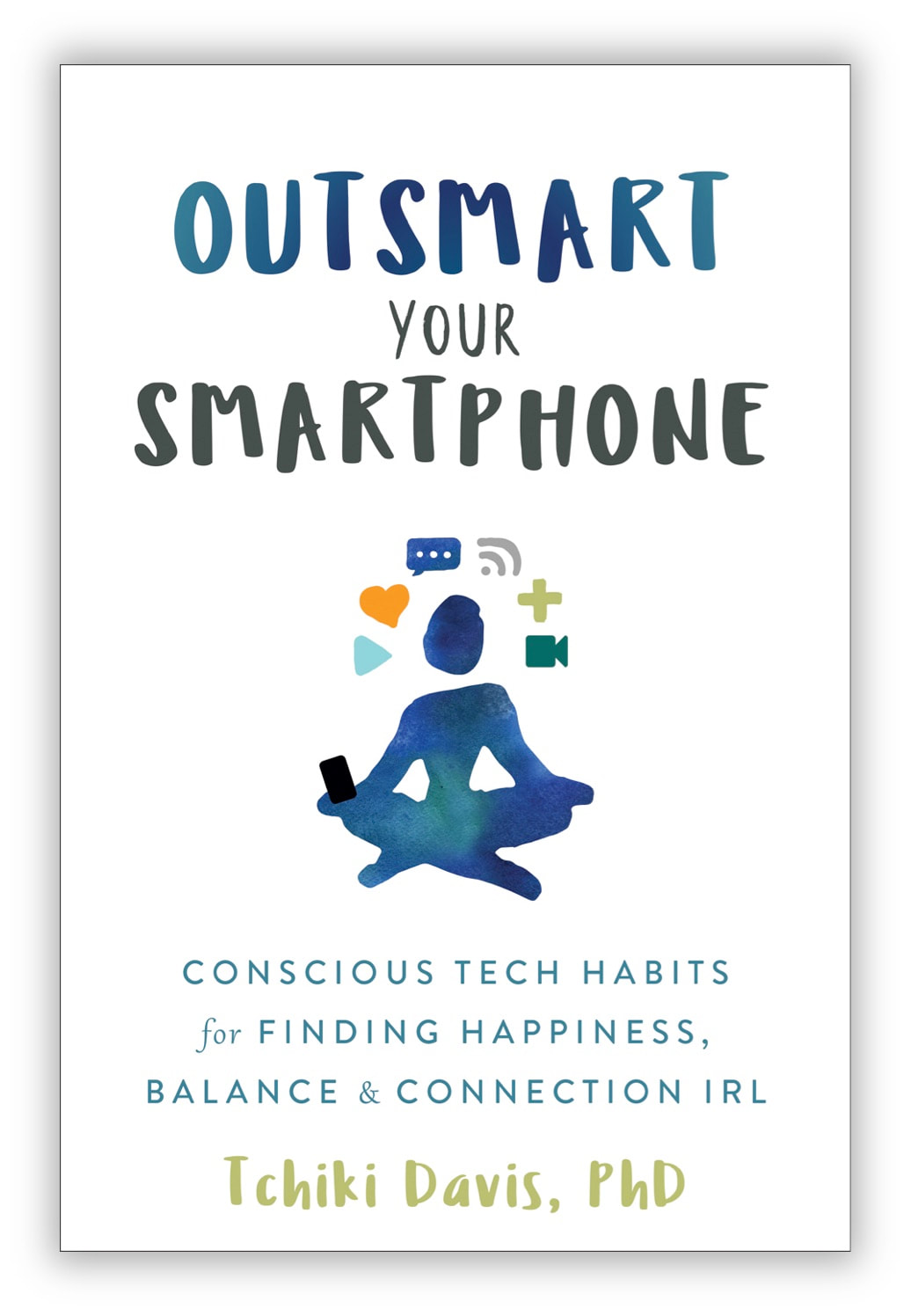
To start, it would do us some good to spend less time on our phones. But, interestingly, it also matters a lot how we spend the time on our phones. Are we stimulating our brain with information or anger? Or are we using our phones to relax and recuperate? To learn more about how to use your phone in ways that are good for you, check out my book, Outsmart Your Smartphone. |
|
6. Slow Down by Doing Something Outside
Indeed, slowing down seems to help us better understand what really matters; and discovering what really matters leads us to want to slow down more. By jumpstarting this process with the support of nature, we can ease our foot off the accelerator of our lives and begin to enjoy the moment a bit more.
7. Slow Down by Having Physical Contact With the Earth
Another interesting area of research shows that a type of bacteria in soil activates brain cells that produce serotonin, a feel-good neurochemical. That means that simply touching soil more frequently may help fight off depression (Lowry et al., 2007). Again, we see how slowing down—in this case by taking the time to remove our shoes or plant a garden—can help us improve our health and well-being.
8. Slow Down by Listening to Binaural Beats
9. Slow Down by Practicing Savoring
10. Slow Down by Taking the Time to Do Enjoyable Things
Setting limits is important, especially because there has been a recent push from our culture and workplaces to be mindful and be grateful for everything. Sure, being grateful is all well and good, but what if our lives just plain need more stuff to be grateful for? Regardless of how many self-help techniques we use, we still need rest and we still need positive experiences.
That’s why we need to do more things we enjoy. They don’t need to be big things—maybe we decide to cook dinner instead of always eating out, or maybe we go for a walk at the end of the day. It’s up to us to make time for the things we love most.
11. Slow Down Your Thoughts

12. Slow Down by Doing Yoga
Yoga involves slow, controlled breathing and slow, careful movements. So ya, it’s slow. It forces us to get more comfortable with stillness and not always rushing to the next thing. And we (hopefully) learn that doing so makes us feel calmer and more centered. And an added bonus is that regular practice of yoga has been shown in research to actually reduce cortisol, one of the main stress hormones (Thirthalli et al., 2013).
13. Slow Down by Breathing Slowly
So, to slow our bodies and minds down, it can help to take some slow, deep breaths. There are lots of ways to do this. Below is a video to guide you through some slow breathing.
Video: Slow Breathing Exercises
14. Slow Down by Detoxing Your Stress
Articles Related to Slowing Down
Books Related to Slowing Down
Final Thoughts Related to Slowing Down
Do you feel like you’re constantly running on the treadmill of life? It’s not always easy to slow down, but it turns out that slowing down can help us imp[rove our well-being. It can also help us feel less stressed while accomplishing more.
Don’t Forget to Grab Our Free eBook to Learn How to
Grow Your Wellness Business Exponentially!
References
- Cashman, K. (2012). The pause principle: Step back to lead forward (Vol. 35, No. 1). Berrett-Koehler Publishers.
- Friend, K. E. (1982). Stress and Performance: Effects of Subjective Work Load and Time Urgency 1. Personnel Psychology, 35(3), 623-633.
- Garcia-Argibay, M., Santed, M. A., & Reales, J. M. (2019). Efficacy of binaural auditory beats in cognition, anxiety, and pain perception: a meta-analysis. Psychological Research, 83(2), 357-372.
- Khalfa, S., BELLA, S. D., Roy, M., Peretz, I., & Lupien, S. J. (2003). Effects of relaxing music on salivary cortisol level after psychological stress. Annals of the New York Academy of Sciences, 999(1), 374-376.
- Khoury, B., Lecomte, T., Fortin, G., Masse, M., Therien, P., Bouchard, V., … & Hofmann, S. G. (2013). Mindfulness-based therapy: a comprehensive meta-analysis. Clinical psychology review, 33(6), 763-771.
- Krick, A., & Felfe, J. (2019). Who benefits from mindfulness? The moderating role of personality and social norms for the effectiveness on psychological and physiological outcomes among police officers. Journal of occupational health psychology.
- Lowry, C. A., Hollis, J. H., De Vries, A., Pan, B., Brunet, L. R., Hunt, J. R., … & Lightman, S. L. (2007). Identification of an immune-responsive mesolimbocortical serotonergic system: potential role in regulation of emotional behavior. Neuroscience, 146(2), 756-772.
- Mourot, L., Bouhaddi, M., Gandelin, E., Cappelle, S., Dumoulin, G., Wolf, J. P., … & Regnard, J. (2008). Cardiovascular autonomic control during short-term thermoneutral and cool head-out immersion. Aviation, space, and environmental medicine, 79(1), 14-20.
- Quoidbach, J., Wood, A. M., & Hansenne, M. (2009). Back to the future: The effect of daily practice of mental time travel into the future on happiness and anxiety. The Journal of Positive Psychology, 4(5), 349-355.
- Rowe, M. B. (1986). Wait time: Slowing down may be a way of speeding up!. Journal of teacher education, 37(1), 43-50.
- Talbot, J. F., & Kaplan, S. (1986). Perspectives on wilderness: Re-examining the value of extended wilderness experiences. Journal of Environmental Psychology, 6(3), 177-188.
- Thirthalli, J., Naveen, G. H., Rao, M. G., Varambally, S., Christopher, R., & Gangadhar, B. N. (2013). Cortisol and antidepressant effects of yoga. Indian journal of psychiatry, 55(Suppl 3), S405.
- Ulrich, R. S., & Parsons, R. (1992). Influences of passive experiences with plants on individual well-being and health. The role of horticulture in human well-being and social development, 93-105.
Are You a Therapist, Coach, or Wellness Entrepreneur?
Grab Our Free eBook to Learn How to Grow Your Wellness Business Fast!
