Think Positive: 16 Simple Ways to Start Thinking Positive

*This page may include affiliate links; that means I earn from qualifying purchases of products.
1. Take the Well-Being Quiz to See How Positive You Are
Are You a Therapist, Coach, or Wellness Entrepreneur?
Grab Our Free eBook to Learn How to
Grow Your Wellness Business Exponentially!
✓ Save hundreds of hours of time ✓ Earn more $ faster
✓ Boost your credibility ✓ Deliver high-impact content
2. Help Your Brain Get Used to Thinking Positive

There are lots of fun ways to build strong positive neural networks using positive words. For example, you could memorize five positive words and set an alarm that reminds you to recall these words, in reverse order, later that evening.
Or, you could print out positive words on strips of paper (or use the flashcard book), cut each word into 2 pieces, shuffle them all together and then match them back up. For example, the word “laughter” would be cut into “laug” and “hter”. To match the word pieces, your brain has to not only retrieve the word laughter, but it also has to search through lots of other positive information to find the word it’s looking for.
If you’re struggling to think positive, these positive memory activities are a great place to start because they are easy, fun, simple, fast, and they can help develop your brain in ways that may make it easier to think positive in other ways.
Here’s a Video to Reprogram Your Mind for Positive Thinking
3. Start Your Day By Using Imagination To Think Positive

Watch This Video to Learn More About Boosting Positivity in the Brain:
In one study, participants used this technique for 14 days in a row, imagining four positive things that could actually happen to them the next day, such as eating a tasty meal or getting hired for a job. At the end of the study, this group showed an increase in happiness, while groups who imagined negative or routine future events did not.
When you imagine you finally start that mission-driven business you’ve been dreaming of or you visualize getting that amazing date you are dreaming of, you are essentially telling your brain to respond as if those things were happening. You create positive emotions out of thin air.

4. Savor Positive Moments To Extend Positive Thoughts
When we learn to savor our moments, we attempt to fully feel, enjoy, and extend our positive experiences. Savoring is a great way to develop a long-lasting stream of positive thoughts and positive emotions because positive events are sometimes infrequent.

5. Capitalize on Positive Moments

|
Capitalizing, like savoring, helps you make the most of positive moments. To capitalize on positive emotions, show them, tell them, or share them with others right away.
Keep in mind that the positive thing that happens doesn’t have to be big. You could simply have woken up on the right side of the bed and think, “Hey, I’m feeling great today.” “Show it” by expressing the positive emotions in your facial expressions and body language. For example, you could smile, laugh, or throw your hands up in the air. These expressions of happiness can help prolong your positive feelings. |
“Share it” by sending a text or message to a friend. If there is something you are feeling great about, particularly something you think would make others feel great too, share it far and wide. Just be careful not to post things that might make other people feel worse (like if you got something that someone else wanted).
6. Pay Attention to the Positive Things

7. Create a Collection of Positive Images or Positive Quotes
There are tons of positive images online, and you can use an online tool, like Pinterest, to collect images of people, places, or things that make you feel positive. These can be photos that you took,
drawings, or other positive things you found online. Feel free to check out my Pinterest collection for inspiration.8. Think Positive, but Think Negative When You Need To
When we are sad or grieving, thinking negative thoughts and showing negative emotions helps us communicate to others that we need their support. When we get angry, our thoughts can help motivate us to take action and make necessary changes in our lives. Casually pushing negative emotions aside without seriously considering what they are trying to tell us can have real consequences.
So when you focus on the negative, ask yourself: is this negative emotion resulting in action that improves your life? If so, then keep it. If not, then work on focusing on the positive.
9. Practice Gratitude To Think Positive
One way to train your brain to focus more on the positive things in life is to practice gratitude. Gratitude is when we feel or express thankfulness for the people, things, and experiences we have. When we express gratitude at work, we can more easily gain the respect and camaraderie of those we work with. When we are grateful for our partners or friends, they are more happy with us. When we are grateful for the little things in our day-to-day lives, we find more meaning and satisfaction in our lives.
One of the easiest ways to practice gratitude is by writing a list of all the things you are grateful for. Try to think of as many things, people, places, etc., as you can. (e.g., Your family, yummy ice cream, rainbows, puppies, etc.
Or you could write down three good things a few days per week. At the end of the week, review your list to remind yourself that you have a lot to be grateful for.
10. Share Your Gratitude With Others To Extend Positive Thoughts
If this seems too intense, you can share your gratitude in smaller ways. Write out a few sticky notes to people who you are grateful for. Include one to two things you appreciate about them and stick the note on their desk, car, or bag. Or practice gratitude on social media by writing short positive messages to the people you feel most grateful for.
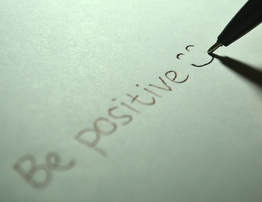
Each day for a week, write down three good things about your day. At the end of the week, review your list to remind you have to be grateful for.
11. Make a Gratitude Drawing To Think Positive With The Right Side of Your Brain

12. Make Positive Emotions by Watching Positive Videos
One way is to watch positive or fun videos.

13. Stop Minimizing Your Successes

As you pursue positive thinking, happiness, or well-being—whatever your goal is—take note of your wins. For every small win, celebrate at least a little bit.
14. Create Positivity Triggers For Spontaneous Positive Thoughts
Pavlov had a dog. Pavlov would ring a bell to tell his dog that it was almost feeding time. Like most dogs, Pavlov’s dog would get really excited when he was about to get fed. So he’d drool all over the place.
What happened? Well, suddenly Pavlov’s dog started getting excited just by the sound of that bell, even when food wasn’t present. Eating food and the sound of the bell became linked in the dog’s brain. Something as meaningless as a bell was now making the dog excited.
This effect is called classical conditioning. It’s the idea that when two stimuli are repeatedly paired, the response that was first elicited by the second stimulus (food) is now elicited by the first stimulus alone (the bell).
This happens all the time without us even realizing it. For example, for many of us, our favorite food is something that we ate as a child with our families. What likely happened was the positive feelings of being with family and the particular food got paired in our brains. As a result, we now get the warm-fuzzy feelings that we got from spending time with family just from eating the food alone, even if our family is not currently present when we eat it.

15. Stop All-Or-Nothing Thinking
Thinking positive is not all about ignoring the bad; it’s about recognizing that there is some good in everything, even the bad. The world is not black or white. Recognizing the shades of grey helps us more easily make room for positive thoughts.
16. Enjoy Your Life
Don’t Forget to Grab Our Free eBook to Learn How to
Grow Your Wellness Business Exponentially!
- Davis, Tchiki S., B. Q. Ford, M. Riese, K. McRae, P. Zarolia, E. Butler, and I. B. Mauss. 2013. “Look on the bright side: Effects of positive reappraisal training on psychological health.” Society for Personality and Social Psychology, Emotion Pre-Conference, New Orleans, LA.
- Emmons, Robert A., and Michael E. McCullough. 2003. “Counting blessings versus burdens: An experimental investigation of gratitude and subjective well-being in daily life.” Journal of Personality and Social Psychology 84 (2):377-389.
- MacLeod, Colin, Elizabeth Rutherford, Lyn Campbell, Greg Ebsworthy, and Lin Holker. 2002. “Selective attention and emotional vulnerability: Assessing the causal basis of their association through the experimental manipulation of attentional bias.” Journal of Abnormal Psychology 111 (1):107-123.
- Quoidbach, Jordi, Elizabeth V. Berry, Michel Hansenne, and Moïra Mikolajczak. 2010. “Positive emotion regulation and well-being: Comparing the impact of eight savoring and dampening strategies.” Personality and Individual Differences 49 (5):368-373.
- Siegle, Greg J., Frank Ghinassi, and Michael E. Thase. 2007. “Neurobehavioral therapies in the 21st century: Summary of an emerging field and an extended example of cognitive control training for depression.” Cognitive Therapy and Research 31 (2):235-262.
- Wadlinger, Heather A., and Derek M. Isaacowitz. 2008. “Looking happy: The experimental manipulation of a positive visual attention bias.” Emotion 8 (1):121-126.