
Your Happiness Plan: 6 Steps to Starting Your Happiness Journey

*This page may include affiliate links; that means I earn from qualifying purchases of products.
Why Do You Need a Happiness Plan?
Are You a Therapist, Coach, or Wellness Entrepreneur?
Grab Our Free eBook to Learn How to
Grow Your Wellness Business Exponentially!
✓ Save hundreds of hours of time ✓ Earn more $ faster
✓ Boost your credibility ✓ Deliver high-impact content
How Do You Create Your Happiness Plan?
Take a moment to think about how you learned math. First, teachers told you which skills you needed to learn — skills like addition, subtraction, multiplication, and division. Then they showed you HOW to practice these skills — by giving you worksheets and activities that helped you build these skills, practicing them over and over again until they were easy.
Most self-help books, courses, and apps do teach you what skills lead to happiness. But they fail to teach you how to build these skills.
Lets go back to the math example to explain. If you were just starting to learn math, a teacher would never have you first try some long division, then try some addition, and then find the circumference of a circle. But this is exactly what people do when trying to teach you happiness.
You’ll often get a bit of mindfulness, then some kindness, then some gratitude. No method to the madness.
Well, it turns out that mindfulness is the equivalent of calculus and kindness is the equivalent of long division? This is why, to successfully increase your happiness, you have to follow the right steps, and practice the right skills, in the right order. It helps to create a plan to be happy.

Create Your Happiness Plan in 8 Steps
Here are 6 steps to help you start creating your own happiness plan.
Step 1: Clarify Why You Are Building Your Happiness
When clarifying your “why“, be specific. Note all the reasons why building your happiness is an important goal for you and why you are willing to put in the effort to do it.
Step 2: Clarify When You’ll Build Your Happiness

By clarifying the exact time when you’ll increase your happiness (in your happiness plan) you make it more likely that you’ll actually do it. By scheduling time for your happiness, you’ll make more progress.

Step 3: Decide What Skills to Build
- Happiness Planning
- Positive Thinking
- Healthy Relationships
- Kindness
- Personal Development
- Emotional Resilience
- Self-Confidence
- Life Purpose
- Work-Life Balance
- Self-Awareness
If you haven’t already, you can take our Happiness Quiz to see how strong you are at these 10 skills. And start building these skills with our Happiness Program.
Some more tips on how to create your happiness plan:
Build Happiness Skills That Have a Bigger Impact on Happiness
As you can see in the figure below, each of the ten top skills is correlated with happiness—but some skills are more strongly correlated with happiness than others. The skills on the left side of the chart are more strongly correlated with happiness. As you move to the right, the skills are less strongly correlated with (i.e., related to) happiness.
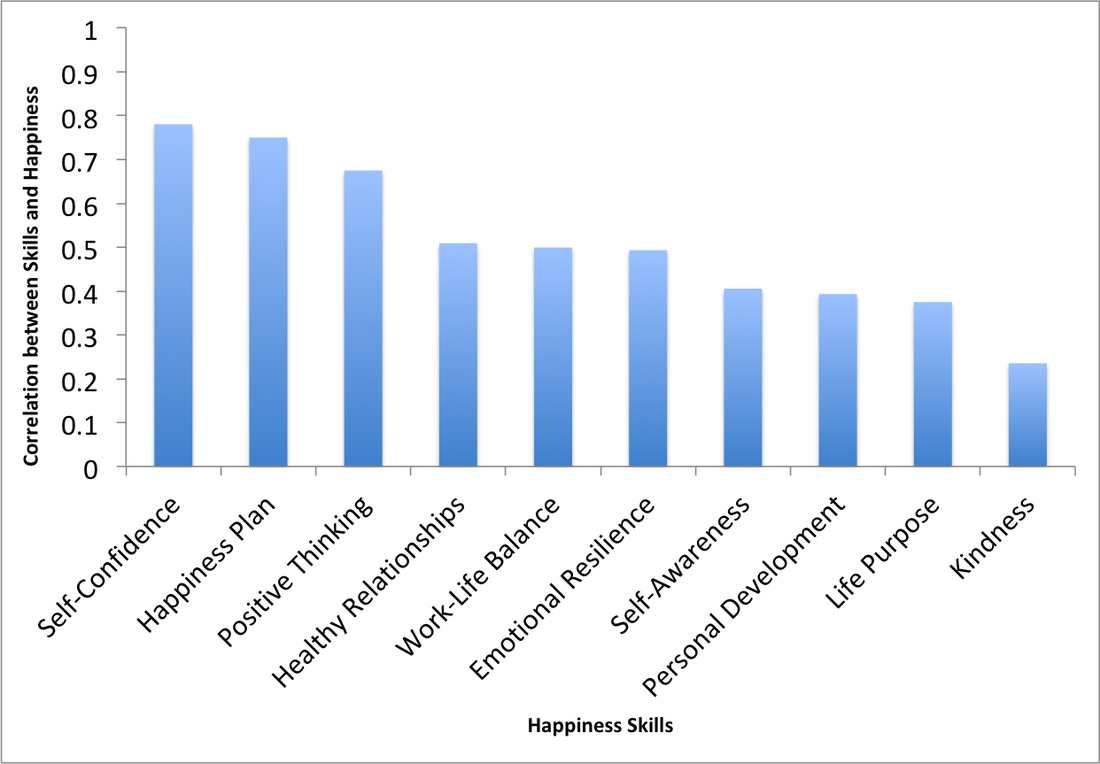
But, you have to be careful with how you interpret this research. It’s easy to think that maybe you should just create a happiness plan with self-confidence and hey, you’re done! Hold on. It’s not quite that easy.
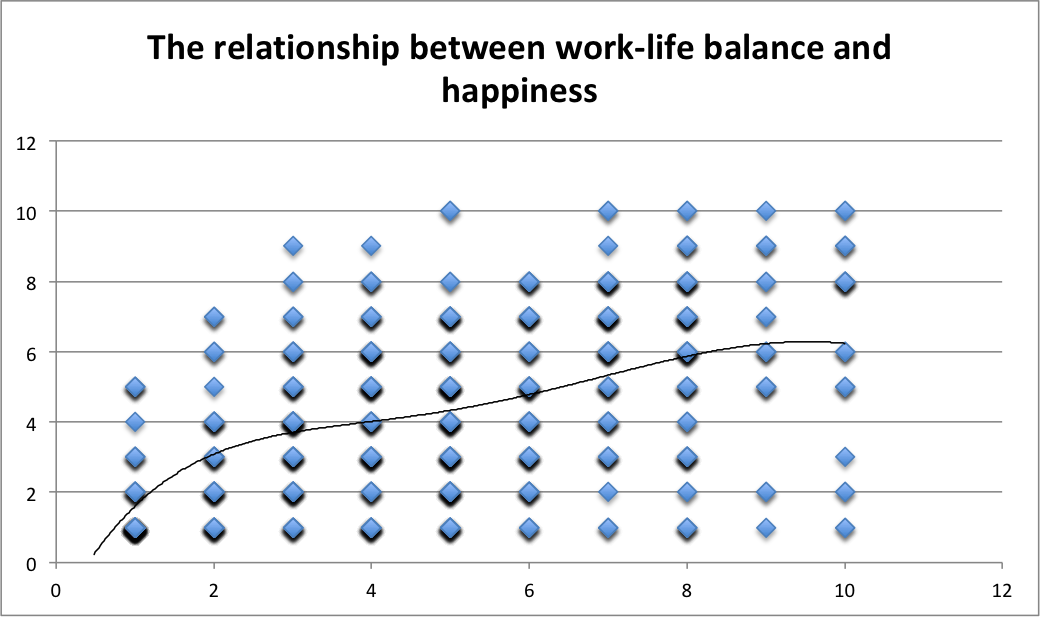
First, the relationship between these skills and happiness is not always linear. For example, if your work-life balance is awful, it has a huge impact in your happiness. If your work-life balance is so-so, then it has a smaller impact on your happiness.
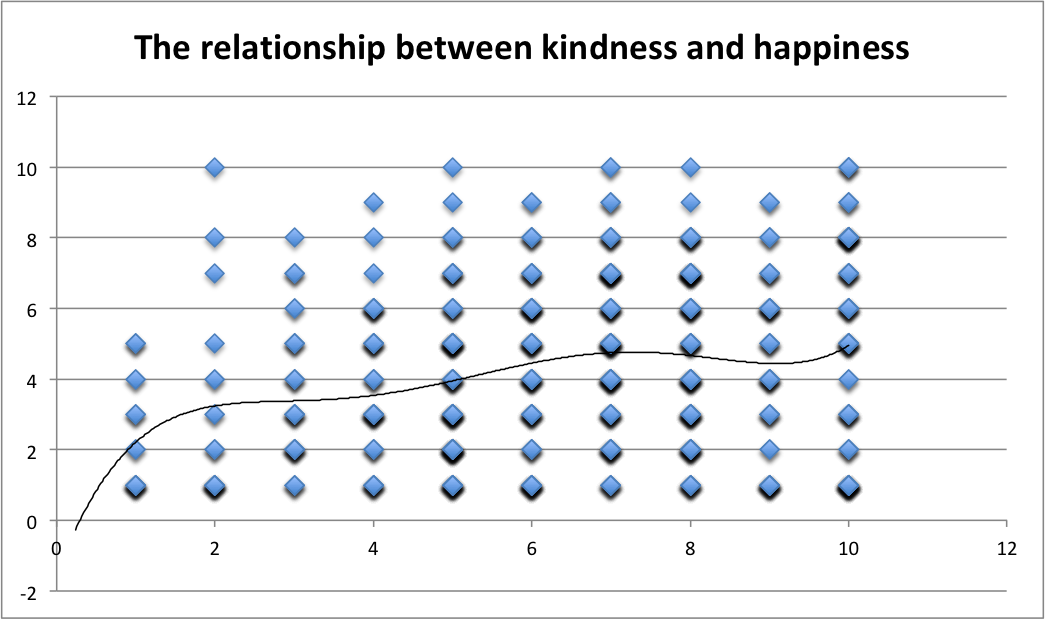
The same is true with kindness. A little kindness goes a long way when it comes to your happiness.
In the figures below, you can see that if your scores are very low on work-life balance or kindness, these skills have a huge impact on your happiness (that’s why the line is very steep). As your scores get a bit better (above a 2 or 3), these skills contribute less to your happiness.
|
|
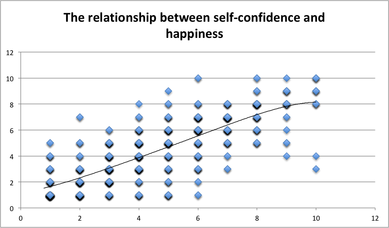
Other skills, like self confidence, are related to happiness no matter what your score. This means that building this skill, regardless of whether your score is high or low, is likely to help you improve your happiness. In the figure below, see how the line is nearly flat? That means each little boost you have in self-confidence is expected to result in a little boost in happiness.
Step 4: Decide What Order to Build These Skills
These guidelines can help you decide what to put first in your happiness plan.

Start Your Happiness Plan by Working on a Happiness Skill That You Are Weaker At
But keep in mind, this is likely also the most challenging approach. Why? Well, these skills wouldn’t be your weak skills if they weren’t already hard for you to build, right? So building these skills wont be easy.
Start Your Happiness Plan by Working on Skills That You Think Will Be the Most Enjoyable
Start Your Happiness Plan by Working on Basic or Easier Skills
There is some evidence suggesting that positive thinking is the easiest skill—which includes gratitude and savoring—but remember, it depends on who you are and what you personally are good at.
Step 5: Commit to Your Happiness Plan
The human brain is silly. We don’t like to let ourselves down or feel like liars. So one little way we can help ourselves stick to our happiness plan is by making a written commitment to ourselves that we will stick to the goals we have set for ourselves.

A happiness planner can help you keep track of your happiness plan:
Step 6: Decide How You Will Build The Skills In Your Happiness Plan
So I’ve aimed to take all these considerations (and more) into account to create a happiness program that helps you build your happiness more strategically. You focus on the basics, the high-impact skills, and the fun stuff first before graduating to more complex topics. Check out the Happiness Program Here to learn more about how you can plan to be happy.
- Baumeister, Roy F., Kathleen D. Vohs, and Dianne M. Tice. 2007. “The strength model of self-control.” Current Directions in Psychological Science 16 (6):351-355.
- Fogg, Brian J. 2009. “A behavior model for persuasive design.” Proceedings of the 4th international Conference on Persuasive Technology.
- Sheldon, Kennon M, and Linda Houser-Marko. 2001. “Self-concordance, goal attainment, and the pursuit of happiness: Can there be an upward spiral?” Journal of personality and social psychology 80 (1):152.
Don’t Forget to Grab Our Free eBook to Learn How to
Grow Your Wellness Business Exponentially!
