
Time Management: Definition, Examples, & Tips
Discover the benefits of time management. Find strategies and tools to develop better time management skills.

*This page may include affiliate links; that means we earn from qualifying purchases of products. |
Balancing all of the demands on your time and energy can be a difficult task. Most people are juggling multiple responsibilities such as parenting, careers, and relationships just to name a few. Throw in self-care activities such as working out and spending time with friends and your schedule can start to feel crowded. Without intention and organization, you might find it challenging to complete all of the tasks you need to complete. |
Before reading on, if you’re a therapist, coach, or wellness entrepreneur, be sure to grab our free Wellness Business Growth eBook to get expert tips and free resources that will help you grow your business exponentially.
Are You a Therapist, Coach, or Wellness Entrepreneur?
Grab Our Free eBook to Learn How to
Grow Your Wellness Business Exponentially!
✓ Save hundreds of hours of time ✓ Earn more $ faster
✓ Boost your credibility ✓ Deliver high-impact content
What Is Time Management? (A Definition)
Why Time Management Is Important
Better time management has been correlated with a number of benefits. One study gave employees a one-and-a-half day time management training to help with procrastination. After one month, the employees reported increased time management skills and decreased worry and avoidance behavior compared to employees who did not receive the training (Eerde, 2003). This means that increasing your time management skills can have a positive effect on your job by encouraging action and decreasing feelings of worry.
Time management can also have benefits in an academic environment. Students who feel they have greater control over their time see the following benefits:
- Less role ambiguity
- Less role overload
- Fewer job stresses
- Greater work satisfaction
- Greater life satisfaction
- Better self-evaluations of performance (Macan et al., 1990)
Feeling like you have greater control over your time is exactly the kind of power that practicing time management gives you. Instead of feeling overwhelmed, you can feel sure and prepared to tackle anything that comes your way.
Video: The Philosophy of Time Management
Examples of Time Management
- Alex would like to develop better habits around eating but she finds herself buying fast food for lunch every day because she doesn’t wake up in time to pack her own. Instead of waking up earlier, which is really difficult for her, she starts to devote one hour to meal prepping on Sunday afternoons. This means she has healthy, affordable meals ready to go all week. She also makes a plan to pack her lunch and snacks the night before so she can just grab them and go in the morning.
- Jose has been busy with school and work lately and his housework has fallen behind as a result. Instead of letting things pile up, he starts to do a little cleaning each day. While making his coffee in the morning, he sets a timer for 15 minutes and cleans up as much as possible during that time. After a few days, he makes a game of his cleaning time, trying to get as much done as he can. Jose starts to enjoy and see the value in keeping his space clean.

Time Management Skills
Goal-setting.
When you have clear goals, you understand all the steps you need to achieve them. This allows you to take action and get things done. Having both long-term goals and short-term goals can help you prioritize and manage the things you need to focus on.
Organization.
Being organized can help you manage time better because you can easily find what you need to find. This includes keeping files and paperwork tidy as well as taking detailed notes.
Planning.
Planning out your day and week can help you stick to your schedule. This allows you to complete everything you need to.
Prioritization.
There are different ways to prioritize. For example, you might choose to complete short, simple tasks first to get them out of the way. Conversely, there might be a complicated task that needs your attention right away. Knowing how to prioritize is an essential piece of time management.
Stress management.
Feeling stressed can make it difficult to manage your time. (Poor time management can also be a cause of stress). Approaching tasks from a calm state of mind will make you more efficient. Try exercises such as yoga, journaling, or meditation to manage stress.
Video: 7 Time Management Strategies for Increased Productivity
Time Management Plan
Example of a daily plan:
- 6:00 am: Wake up
- 6:30-7:30 am: Work out
- 7:30-8:30 am: Get ready and eat breakfast
- 9:00-12:00 pm: Work
- 10:00-10:15 am: Drawing break
- 12:00-1:00 pm: Lunch+walk outside
- 1:00-5:00 pm: Work
- 2:30-2:45 pm: Coffee break
- 5:00-7:00 pm: Eat dinner and relax
- 7:15-7:45 pm: Practice guitar
- 7:45-8:00 pm: Meditate
The plan above includes responsibilities, such as work, and hobbies, such as practicing guitar. Mindful, rejuvenating breaks are also built into the plan. It’s okay if obstacles alter the course of your plans–they inevitably will. Having a structure gives you something to come back to once the obstacle is taken care of.
Time Management Tips
Pomodoro Method
This method can help you take action and get things done if you are having trouble getting started. Set a timer for 25 minutes and work straight through with no distractions. When the timer is up, take a 5-minute break. Repeat this cycle until you get your task completed.
Eat the Frog
“Eating the frog” is a time management tool that refers to doing the biggest or most unpleasant task first. Getting this task out of the way means it won’t be hanging over your head. Plus, getting the most difficult task done first can help serve as motivation for the rest of your day.
Build in Breaks
While it can be tempting to pack your day with activities, it is also important to build in breaks. Research has shown that building in breaks with regenerative activities, such as walks or meditation, can boost productivity and overall well-being (Taylor, 2005). When you build a time management plan, try to include breaks. Even five or ten minutes can be beneficial.
Video: The Secrets of Modern Time Management
Time Management Games
How Long is a Minute?
- Tell people you will be testing their perception of time.
- Ask people to close their eyes and instruct them to open their eyes once they feel one minute has elapsed.
- Time one minute using a phone or stopwatch.
- Some people will open their eyes before the minute is over and some after. Discuss how different people perceive time differently.
Spend $86,400
- Instruct people that they have $86,400 to spend in one day. The amount cannot carry over. You have to spend the full amount in one day.
- Write down the activities you/others would spend the money on.
- Talk about the fact that we all have 86,400 seconds each day.
- Evaluate how much money was “wasted” and compare it to wasted time.
- Discuss ways to take back control of the time you have each day.

Time Management Quadrants
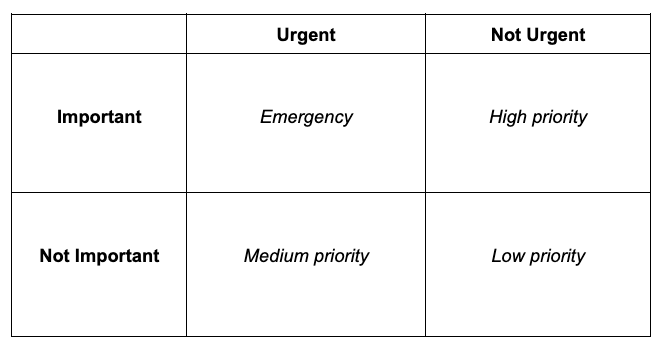
Quadrants are a great tool to prioritize what needs to get done and identify what can wait. You can use quadrants when completing weekly or monthly planning. Both planning and prioritizing using quadrants are examples of common time management tools. Try using the matrix below to visualize what you should prioritize. Evaluate whether each task is important vs. not important and urgent vs. not urgent and place it in the appropriate box. This will give you a better idea of what is an emergency, high priority, medium priority, and low priority.
Quotes on Time Management
- “Where your attention goes, your time goes.” ― Idowu Koyenikan
- “The bad news is time flies. The good news is you’re the pilot.” ― Michael Altshuler
- “By failing to prepare, you are preparing to fail.” ― Benjamin Franklin
- “Lack of direction, not lack of time, is the problem. We all have twenty-four-hour days.” ― Zig Ziglar
- “If you spend too much time thinking about a thing, you’ll never get it done.” ― Bruce Lee
- “You get to decide where your time goes. You can either spend it moving forward, or you can spend it putting out fires. You decide. And if you don’t decide, others will decide for you.” ― Tony Morgan
- “Time is the most valuable coin in your life. You and you alone will determine how that coin will be spent. Be careful that you do not let other people spend it for you.” ― Carl Sandburg

Articles Related to Time Management
Books Related to Time Management
Final Thoughts on Time Management
Do you feel like you are always busy but can’t seem to get anything done? Creating structure around your time can help you gain control if you feel overwhelmed. With some forethought and practice, you can learn to manage your time in a more efficient way. This means that you can have time for all of your responsibilities while also creating space for the activities you enjoy.
There are several skills you can work on to further your time management abilities. These include organization, goal-setting, and stress management. You can also try different tools, such as “eat the frog” or the Pomodoro method, to complete tasks. Keep trying until you find the set of skills and tools that works best for you. Gaining back control of your time can help you gain back more control of your life.
Don’t Forget to Grab Our Free eBook to Learn How to
Grow Your Wellness Business Exponentially!
References
- Eerde, W. V. (2003). Procrastination at work and time management training. The Journal of Psychology, 137(5), 421–434.
- Macan, T. H., Shahani, C., Dipboye, R. L., & Phillips, A. P. (1990). College students’ time management: Correlations with academic performance and stress. Journal of Educational Psychology, 82(4), 760–768.
- Taylor, W. (2005). Transforming work breaks to promote health. American Journal of Preventive Medicine, 29(5), 461–465.
Are You a Therapist, Coach, or Wellness Entrepreneur?
Grab Our Free eBook to Learn How to Grow Your Wellness Business Fast!
