
Mindsets: Definition, Examples, and Books (Growth, Fixed + Other Types)
What are mindsets (growth, fixed, positive, scarcity, etc…)? And how do you cultivate a mindset for success? Learn here about the science behind mindsets and how it can change your life.

*This page may include affiliate links; that means I earn from qualifying purchases of products.
What Is the Definition of Mindset?
Mindset is defined as the set of attitudes or beliefs that we hold. Mindset is crucially important because our attitudes and beliefs affect everything we do, feel, think, and experience. Our mindset influences our perceptions and how we move through the world. Although we have one overall mindset, this can be made up of many smaller mindsets. Some of these help us improve our well-being and succeed in the world. Others hurt our ability to do so. That’s why developing certain mindsets can greatly help us reach our goals, enjoy our lives, and be more successful. Here we’ll talk about some of the most beneficial mindsets and how you can develop them.
Are You a Therapist, Coach, or Wellness Entrepreneur?
Grab Our Free eBook to Learn How to
Grow Your Wellness Business Exponentially!
✓ Save hundreds of hours of time ✓ Earn more $ faster
✓ Boost your credibility ✓ Deliver high-impact content
What Are Mindsets?
Each of these mindsets exists on a continuum, which goes from having 100% of this mindset to having 0% of it. So you will fall somewhere on the continuum for each mindset type below:
- Growth Mindset <> Fixed Mindset
- Positive Mindset <> Negative Mindset
- Entrepreneurial Mindset <> Worker Bee Mindset
- Abundance Mindset <> Scarcity Mindset
- Challenge Mindset <> Threat Mindset
- Mindful Mindset <> Mindless Mindset
|
These mindsets are changeable. If you fall on the low side of any continuum, you can engage in thought exercises and activities to push yourself up the continuum towards more beneficial mindsets. So let’s talk a bit more about each of these mindsets and how they can be developed. |
Focus Music for Work & Study
|
What is a Growth Mindset?
Sometimes it can be hard to see how a growth mindset can help us be happier and reach our goals. Here are some growth mindset examples to give you more insight.
- Henry failed his math test. Instead of thinking he’s not smart, he sees this experience as an indication that he needs to study harder.
- Da’Sean wants to change jobs but he will need to be a great public speaker to get the job he wants. But this is no worry to him because Da’Sean knows that he can go to toastmasters and practice public speaking until he gets good enough to get the new job.
- Carla has just lost 100 lbs and wants to see the view from the top of a 14er (a mountain 14,000 feet above sea level). She is scared because she has never done anything like this before. But now that she has lost all the weight, she knows that she can do anything. So she goes for small hikes, then larger ones, and in a year, she makes it to the top of a 14er.
What is a Fixed Mindset?
A fixed mindset is the opposite of a growth mindset. It is the tendency for people to believe that their abilities can not be developed and that they are born with whatever level of smarts they have. A fixed mindset can be a roadblock to achieving your goals because you may be less likely to believe that your goals are achievable. Why put in the work if you don’t think the work will be worth the effort? If you find that you often have a fixed mindset, try to start thinking about ways to develop a growth mindset and improve your skills.
Fixed vs Growth Mindset
Rule #1
Those with a fixed mindset strive to look talented to others. Those with a growth mindset strive to learn.
Rule #2
Those with a fixed mindset believe they shouldn’t work too hard. In fact, having to work hard must mean you’re not talented. Carol Dweck suggests this may be because fixed mindset individuals were naturally good at things when they were young. They didn’t have to work as hard so later in life when they reach their natural limits, they have a harder pushing through them.
Those with a growth mindset believe in working with passion and dedication, always striving to give their best effort. These individuals may have had to struggle and work hard for success. As a result, they learned that their efforts really do matter and that they can improve their life skills.
Rule #3
Those with a fixed mindset believe they shouldn’t attempt things they might fail at and they hide their weakness from others. Those with a growth mindset are not afraid of failure and aim to improve upon their weaknesses even if they look silly or stupid in the process.
Remember though, virtually no one has a 100% fixed or growth mindset. We likely have some aspects of each and we benefit from trying to move more towards the growth mindset side of the continuum.
What Is a Positive Mindset?
A positive mindset can be great for our well-being and even help us to be more successful. In fact, the broaden and build theory of positive emotion suggests that positive emotions build on themselves, eventually leading to things like professional and relationship success (Fredrickson, 2004).
Positive Mindset Examples
- Greg decides he wants to start a business that one day makes a million dollars. He’s optimistic about the likelihood of success.
- Arjun completely bombs an assignment at work. But he looks at the experience as a positive because he’s grateful to have a job that challenges him and glad to have the opportunity to try something new.
- Elaine’s job can be dull. But she doesn’t see it that way. She finds ways to make it fun and do nice things for her coworkers, which makes her happy.
Entrepreneurial Mindset
According to a whitepaper on entrepreneurial mindset (Gold & Rodriguez, 2018), this mindset is made up of several important skills including:
These skills are thought to aid academic and career success. Of course, this is a broad range of skills and no one person likely has high levels of all of these skills. Developing the skills we are weaker at may be the most beneficial.

What Is a Scarcity Mindset?
The researchers believe that
scarcity changes how people allocate attention. For example, when money is tight, each bill is more urgent and threatening. Because humans are designed to pay attention to threats and negative things more than positive things (this is referred to as a negativity bias), lack of money can occupy much of people’s mental resources. In sum, having less of something elicits greater focus on that thing (Shah, Mullainathan, & Shafir, 2012).Scarcity mindset changes how we make decisions and solve problems. We’re so focused on what we lack in the moment, we fail to allocate our attention to the longer-term. As a result, we make decisions that overly prioritize our pressing needs at the expense of our longer-term needs. We get stuck in this cycle of short-term thinking and in the longer-term, we end up worse off.
|
Although the research on scarcity mindset is around poverty, there is no reason why it wouldn’t apply to other areas of our lives.
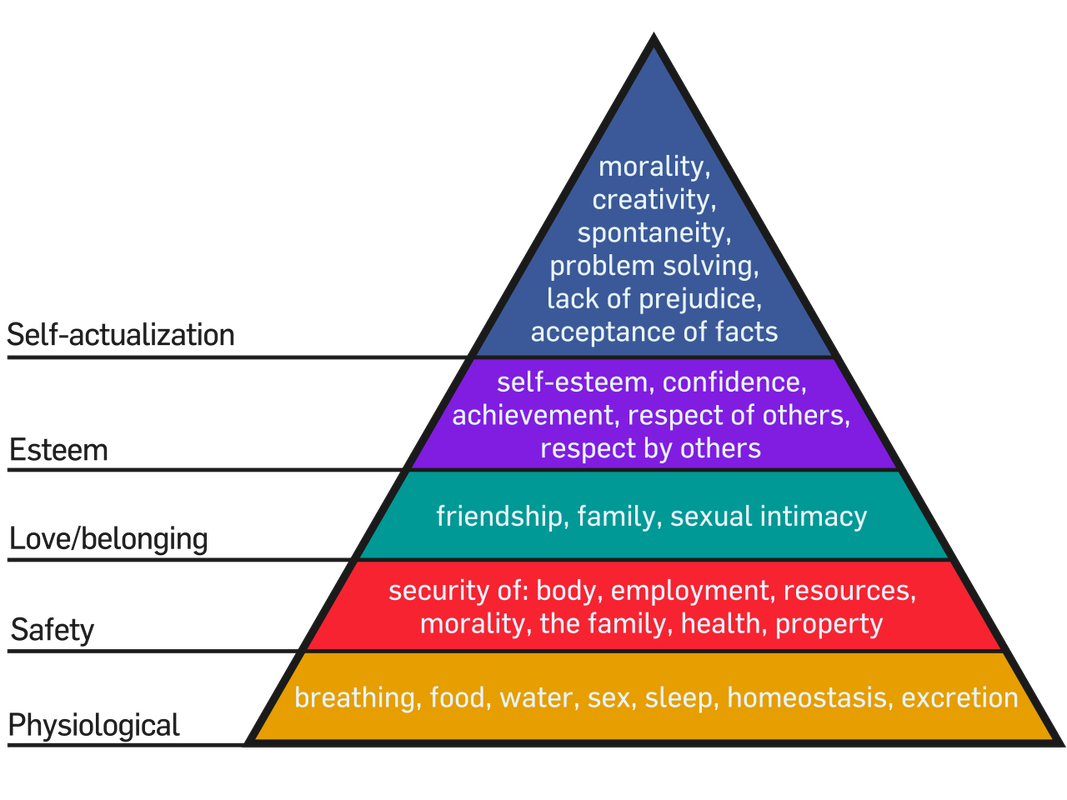
If we are lacking other basic needs like safety, health, love & belonging, self-esteem, freedom, or respect, we may be similarly over-focused on the need that is unfulfilled, and we may focus less on ensuring our other needs are met in the future. |
|
Some research even shows that time scarcity results in scarcity mindset. If we’re really busy, we attend to urgent needs at the expense of longer-term needs. More specifically, busyness results in a crisis mentality—it leads people to resolve current crises while failing to prevent future ones. This results in a greater number of total crises because some could have been prevented (Perlow, 1999). So overall, scarcity mindset keeps up from focusing on how to have a better future.
Scarcity Mindset vs Abundance Mindset
Scarcity mindset comes about as a result of our circumstances and it becomes a cycle, feeding itself until it’s resolved. Personally (and as someone who grew up in poverty), I don’t think switching to an abundant mindset in the midst of a crisis is that simple. Further, deciding to shift to a mindset of abundance when we have bills to pay might, in fact, lead us to make bad decisions. We might buy something we can’t afford or fail to pay the rent because we are not overly focused on our pressing needs. Basically, our emotions and attention are designed to help us. Overriding in the context of a crisis is potentially dangerous.
Abundance Mindset
When we’ve overcome challenges and stresses, we learned that our strategies worked for us. But now if we are in a lower-stress context the same strategies tend not to be the best ones. We need to realize that we are safe and our needs are being met so that we can focus on the future and how to ensure that our needs continue to be met.
Challenge Mindset vs Threat Mindset
This mindset is about how we evaluate the demands of the situation and our resources for coping with these demands. Resources may include skills, knowledge, abilities, dispositions (like positive self-esteem), and external support. Demands may include danger, uncertainty, and required effort (Blascovich et al., 2004). The thing is that most of these resources and demands are attitudes, perceptions, and other cognitions—things that we have the power to change.
By pushing ourselves to see our difficult circumstances as challenges that we can handle, we actually respond to these situations in ways that are more beneficial. A challenge mindset changes our physiology in ways that can make us more successful at the task (Blascovich et al., 2004).
Examples of a Challenge Mindset
- Yvonne might tell herself “I can do it!” when running a marathon.
- Alabaster might tell himself that “I can handle anything they throw at me,” when work is getting nearly too intense to handle.
- Louise might believe that she has the skills to recover from her depression; she just has to keep at it.
Mindful Mindset
Mindless Mindset

Books Related to Mindsets
Articles Related to Mindsets
Final Thoughts on Mindsets
When it comes to developing beneficial mindsets there are lots to choose from. Building a little bit of any of these mindsets can help you get on track towards achieving your goals and living the life you want.
Don’t Forget to Grab Our Free eBook to Learn How to
Grow Your Wellness Business Exponentially!
References
- Blascovich, J., Seery, M. D., Mugridge, C. A., Norris, R. K., & Weisbuch, M. (2004). Predicting athletic performance from cardiovascular indexes of challenge and threat. Journal of Experimental Social Psychology, 40(5), 683-688.
- Carson, S. H., & Langer, E. J. (2006). Mindfulness and self-acceptance. Journal of rational-emotive and cognitive-behavior therapy, 24(1), 29-43.
- Dweck, C. S. (2009). Mindsets: Developing talent through a growth mindset. Olympic Coach, 21(1), 4-7.
- Dweck, C. (2015). Carol Dweck revisits the growth mindset. Education Week, 35(5), 20-24.
- Fredrickson, B. L. (2004). The broaden–and–build theory of positive emotions. Philosophical Transactions of the Royal Society of London. Series B: Biological Sciences, 359(1449), 1367-1377.
- Gold, T., & Rodriguez, S. (2018). Measuring entrepreneurial mindset in youth: Learning from NFTE’s Entrepreneurial Mindset Index. Network for Teaching Entrepreneurship.
- Perlow, L. A. (1999). The time famine: Toward a sociology of work time. Administrative science quarterly, 44(1), 57-81.
- Quoidbach, J., Mikolajczak, M., & Gross, J. J. (2015). Positive interventions: An emotion regulation perspective. Psychological bulletin, 141(3), 655.
- Shah, A. K., Mullainathan, S., & Shafir, E. (2012). Some consequences of having too little. Science, 338(6107), 682-685.
- Yeager, D. S., Hanselman, P., Walton, G. M., Murray, J. S., Crosnoe, R., Muller, C., … & Paunesku, D. (2019). A national experiment reveals where a growth mindset improves achievement. Nature, 573(7774), 364-369.
Are You a Therapist, Coach, or Wellness Entrepreneur?
Grab Our Free eBook to Learn How to Grow Your Wellness Business Fast!
for your free personalized well-being report.
