
Self-Soothing: Definition + 14 Techniques & Skills
Feeling upset? Need to calm yourself down and undo the anxiety already? Discover science-based self-soothing techniques to help you build skills that help you more easily self-soothe.

*This page may include affiliate links; that means I earn from qualifying purchases of products.
What Is Self-Soothing? (A Definition)
Self-soothing is often discussed in the context of childhood development. Indeed, we learn many of our self-soothing patterns when we are babies. It is believed that when we are soothed by care-givers, we internalize this soothing and learn how to do it for ourselves (Wright, 2009). So there are a variety of ways that we might not quite develop this skill well enough and end up having difficulty self-soothing as adults. Improving our self-soothing skills as adults requires self-insight, the development of self-soothing skills, and the ability to effectively use these skills to return to emotional baseline.
Self-Soothing in DBT (Dialectical Behavior Therapy)
Self-soothing is also thought to be a tool for distress tolerance, a key component of Dialectical Behavior Therapy (DBT). In this view, self-soothing is defined as self-comforting, self-nurturing, and being kind to oneself, often by engaging in pleasant activities (Wright, 2009).
In this article, we’ll take a broad view to help you learn a variety of self-soothing techniques and skills. Practicing these techniques and skills can help you self-soothe and better manage and recover from emotional distress.
Are You a Therapist, Coach, or Wellness Entrepreneur?
Grab Our Free eBook to Learn How to
Grow Your Wellness Business Exponentially!
✓ Save hundreds of hours of time ✓ Earn more $ faster
✓ Boost your credibility ✓ Deliver high-impact content
Self-Soothing Techniques
Self-soothing is all about emotions and understanding the different tools we have to manage them. From a psychological perspective, this might include changing our mindset or attention in order to decrease the negative impact of events, learning how to handle, reduce, or shift negative emotions that we’re experiencing, and short-circuiting thought processes that may lead negative emotions to linger instead of resolving. There are also some relevant techniques on how to shift our diet and routines to help us better self-soothe. We’ll talk about many of these self-soothing techniques below.
1. Listen to Relaxing Music to Support Self-Soothing
Listening to relaxing music has been shown in research to reduce cortisol (an important stress hormone; Khalfa et al., 2003). And music with binaural beats (music with two tones played at slightly different frequencies to each ear) may be helpful for focus and calming the mind (Garcia-Argibay, Santed, & Reales, 2019).
If you’re feeling agitated or unable to settle down, calming music might just help change the mood, enabling you to breathe deeper, refocus your thoughts, and nudge negative emotions into remission. Check out the audio/video below for some of my favorite self-soothing music.
2. Take Slow, Deep Breaths to Sooth Yourself
We can easily activate the parasympathetic nervous system by taking a few long, deep breaths. One easy breathing strategy to remember is box breathing. Box breathing involves breathing in for a count of four, holding for a count of four, breathing out for a count of four, and then holding for a count of four. Repeat this box breathing method for a few rounds until you start to calm down.

3. Visualize a Situation That You Find Soothing
All you do is lay down comfortably, close your eyes, and imagine yourself in a place that makes you feel calm. For me, it’s usually the garden. I imagine smelling fresh carrots just pulled from the earth and then laying on the grass in the sun. What about you? What is your calming place?
4. Try ‘The Butterfly Hug’ to Desensitize Yourself
The video below shows you how to do the Butterfly Hug. The goal is not to judge any emotions that come up and stop when you feel “in your body” (Jarero & Artigas 2016).
Video: Self-Soothing with EMDR
5. Soothe Yourself With Pleasant Activities
6. Self-Soothe With a Cold Shower or Swim
I’ll often use this soothing
technique after exercising or after sitting in the sauna and find that even a few minutes of a cold shower helps me feel calmer. So if you’re having a hard time calming yourself down, a cold shower can be a helpful trick.
Self-Soothing Skills
In addition to using self-soothing techniques, we can also build skills that help us soothe ourselves more easily. Building these skills can make it so that we have to rely on the techniques (or tools) less frequently, and we strengthen our brains in ways that help us self-soothe more quickly or even automatically. Read on to discover some of these skills.
1. Self-Reflect on Your Triggers
First, we can try not to get ourselves in situations that upset us—for example, we can try to avoid that coworker that makes our blood boil as often as we can or we can stop ourselves before we get into that same argument with our mother.
Second, we can explore common themes for when we get upset. Ask yourself, do your emotions get out of control when you’re tired or hungry? In this case, perhaps modifying your schedule to eat more often and sleep longer hours is what you really need.
Third, try to reflect on whether there are specific thought processes that are making or keeping you upset. Are you ruminating—running the situation over in your mind again and again? Or are you catastrophizing—imagining the worst possible outcomes? Or maybe, it’s your inner critic—that little voice in your head that tells you that you’re not good enough.
Whatever thought processes get you stuck, it’s good to know what they are so you can start talking back to these thoughts. Tell them why they are wrong—or at least unhelpful—so that you can get your mind back.
2. Self-Sooth With Positive Emotions
If we can just jumpstart our positive emotions, research suggests that this can help fuel an upward spiral of positivity (Fredrickson, Mancuso, Branigan, & Tugade, 2000). Positive emotions help us feel better, helping us to have better social interactions, more success, and so forth. Of course, it’s not always easy to flip the switch and feel more positively. So give yourself time and try to appreciate any small bit of progress.
3. Cultivate Mindful Awareness and Non-Judgement
Mindful meditation can be a helpful way to build this skill. In mindful meditation, you practice being aware and accepting of things like your breath and your body. To try it, check out the meditation video below.
4. Soothe Yourself With a Break From Technology
|
By now, we’ve probably all heard that spending too much time on our phones and other devices isn’t so good for our well-being. Indeed, Internet use is associated with more depression and loneliness (Kraut et al., 1998). Even as someone who managed not to get addicted to my phone, I notice that spending more time on the computer starts to make me kind of agitated. I feel just kind of… off—not quite content.
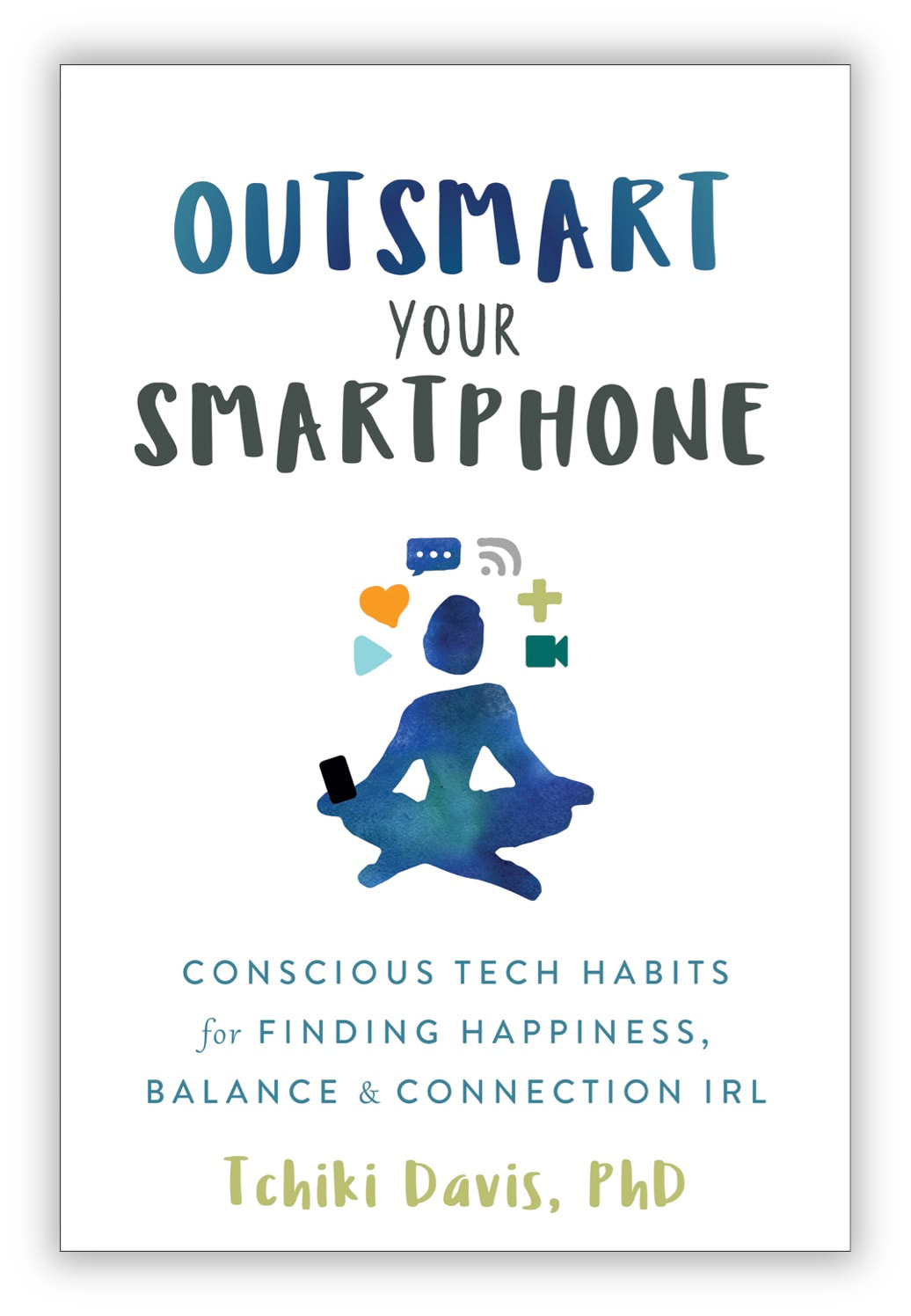
On the plus side, short breaks from technology can go a long way. To learn some tips for having a better relationship with technology, check out my book, Outsmart Your Smartphone and be sure to take a day off from phones and computers every now and then. |
|
5. Self-Sooth by Redirecting Negative Thoughts
As an expert ruminator, I know firsthand how hard it can be to stop the negative thought cycles. Here is a strategy that I’ve been practicing lately that is doing some good.
Consider using positive affirmations to redirect negative thoughts into positive thoughts about the self. For example, if I find myself going down a rabbit hole, thinking about how awful a situation might turn out to be, I try to switch to saying my good qualities out loud. I might say, “I am kind, I am smart, I am loyal”. I find this is often more helpful than thinking about the positives in the situation because then when I do that, I’m still thinking of the situation. Switching the brain to focus on the positives of a completely different subject—the self—seems to direct the brain away from negative thoughts more effectively.
Video: Affirmations for a Peaceful Mind
More Self-Soothing Tips
Here are a few more ways that help some people self-soothe. Feel free to take what’s useful to you and leave the rest.
1. Eat a Self-Soothing Diet
First, we can decrease the stress hormone load in our bodies by reducing our intake of caffeine, green/black tea, coffee, and chocolate.
Next, we can eat foods that research suggests help us feel calmer. Foods like sauerkraut, kimchi, and kefir appear to help reduce anxiety, at least in some people (Hilimire, DeVylder, & Forestell, 2015). Eating some healthy carbohydrates can also increase the release of serotonin, a feel-good hormone (Wurtman & Wurtman 1995). Just be careful not to overdo it or eat junk food, as this can lead to inflammation, which is not so good for our well-being.

2. Get Outdoors to Sooth Yourself
A recent research review suggests that daily contact with nature can help reduce anxiety, depression, and even health conditions like diabetes (Soga, Gaston, & Yamaura, 2017). Indeed, there is thought to be a calming effect of nature. Whether it’s the sun, fresh air, or the scent of trees—all things that have been shown to be good for us—getting outdoors seems to improve our well-being. So if you’re feeling in need of something soothing, going for a short walk or looking up at some tall trees may help.
Articles Related to Self-Soothing
Books Related to Self-Soothing
Final Thoughts on Self-Soothing
When we’re feeling upset, it can sometimes be hard to self-soothe. But by using some self-soothing techniques and building some skills, we actually do have a lot of control over how we feel.
Don’t Forget to Grab Our Free eBook to Learn How to
Grow Your Wellness Business Exponentially!
References
- Fredrickson, B. L., Mancuso, R. A., Branigan, C., & Tugade, M. M. (2000). The undoing effect of positive emotions. Motivation and emotion, 24(4), 237-258.
- Garcia-Argibay, M., Santed, M. A., & Reales, J. M. (2019). Efficacy of binaural auditory beats in cognition, anxiety, and pain perception: a meta-analysis. Psychological Research, 83(2), 357-372.
- Hilimire, M. R., DeVylder, J. E., & Forestell, C. A. (2015). Fermented foods, neuroticism, and social anxiety: An interaction model. Psychiatry research, 228(2), 203-208.
- Jarero, I., & Artigas, L. (2016). Instruction for the Butterfly Hug Method.
- Khalfa, S., BELLA, S. D., Roy, M., Peretz, I., & Lupien, S. J. (2003). Effects of relaxing music on salivary cortisol level after psychological stress. Annals of the New York Academy of Sciences, 999(1), 374-376.
- Kraut, R., Patterson, M., Lundmark, V., Kiesler, S., Mukophadhyay, T., & Scherlis, W. (1998). Internet paradox: A social technology that reduces social involvement and psychological well-being?. American psychologist, 53(9), 1017.
- Linehan, M. M. (1993). Skills training manual for treating borderline personality disorder. Guilford press.
- Mourot, L., Bouhaddi, M., Gandelin, E., Cappelle, S., Dumoulin, G., Wolf, J. P., … & Regnard, J. (2008). Cardiovascular autonomic control during short-term thermoneutral and cool head-out immersion. Aviation, space, and environmental medicine, 79(1), 14-20.
- Soga, M., Gaston, K. J., & Yamaura, Y. (2017). Gardening is beneficial for health: A meta-analysis. Preventive medicine reports, 5, 92-99.
- Wright, J. (2009). Self‐Soothing—A recursive intrapsychic and relational process: The contribution of the Bowen theory to the process of self‐soothing. Australian and New Zealand Journal of Family Therapy, 30(1), 29-41.
- Wurtman, R. J., & Wurtman, J. J. (1995). Brain serotonin, carbohydrate‐craving, obesity and depression. Obesity research, 3(S4), 477S-480S.
Are You a Therapist, Coach, or Wellness Entrepreneur?
Grab Our Free eBook to Learn How to Grow Your Wellness Business Fast!
