
Personal Growth: Definition, Goals, & Examples
Learn about the stages of personal growth, and discover tips to grow.
*This page may include affiliate links; that means we earn from qualifying purchases of products. |
Personal growth is an individual pursuit—each of our personal growth journeys is different. Although the path we take to pursue personal growth may be different, we all must grow along certain personal growth lines and go through specific stages in each of those lines. Here, we discuss these stages and lines of personal growth to help guide and smooth your journey. Specifically, we’ll talk about what personal growth means and how to pursue personal growth in ways that both suit you and get you where you want to go. |
Are You a Therapist, Coach, or Wellness Entrepreneur?
Grab Our Free eBook to Learn How to
Grow Your Wellness Business Exponentially!
✓ Save hundreds of hours of time ✓ Earn more $ faster
✓ Boost your credibility ✓ Deliver high-impact content
What Is Personal Growth? (A Definition)
Opposite of Personal Growth
Although we are always growing in some way, it is human nature to thwart or resist personal growth. We may refuse to learn from our experiences, blame others for our struggles instead of taking responsibility for ourselves, or find ourselves repeating the same patterns over and over again without changing our perspectives (Shutan, 2024). In these cases, we still grow, albeit at a slower pace than we might otherwise have.
As Carl Jung said, “What you resist persists.” Indeed, it is generally better for our well-being to accept, rather than resist, personal growth. We do have the choice to remain as we are, but it often gets more and more uncomfortable (even painful) to resist personal growth, as personal evolution is a natural process (Tolle, 2006).
Causes of Personal Growth

Benefits of Personal Growth
Theory of Personal Growth
Within each line, personal growth is also thought to occur in waves, stages, or spirals (Wilber, 2001). Visually, personal growth may look more like a staircase than a hill, and we will hop forward and jump backward many times as we climb the staircase of our personal evolution. Practically speaking, this can feel like the momentary lightbulb insight that illuminates our brain. Then we quickly find ourselves falling back into old habits before eventually moving forward again, perhaps more slowly, and eventually achieving more permanent personal growth in a given area.
Lines of Personal Growth
Note. There may be other ways to group these skills. This is just one way that helps us more easily understand general categories of personal growth. Keep in mind that in this view, each line (or group) has multiple strands (like a rope) and we likely need to develop many of these individual strands.
- Stability. Grounding, connection to the physical body, financial stability, habits, sense of safety, etc…
- Emotion. Emotion regulation, nervous system activation, fear, physical movement, sexuality, etc…
- Self. Identity, self-esteem, ego, self-expression, achievement, etc…
- Other. Social connection, love, kindness, compassion, forgiveness, etc…
- Self-Other. Communication, listening, voice, boundaries, leadership, etc…
- Mind. Thinking, learning, analyzing, imagination, intuition, etc…
- Soul. Play, surrender, oneness, spirituality, etc…
Although I have described these lines as separate, they overlap and are integrally connected. Think of them more like a braid. A braid cannot exist without all the lines supporting it. And although we move forward in each line separately, moving forward in any one of these lines will affect our progression in the other lines.
Stages of Personal Growth
Perspective Shifts at Each Stage of Personal Growth
The following approach shows how our perspective changes as we progress through the stages within each line (Wilber, 2001).
Perspective stages of personal growth:
- Preconventional (egocentric)
- Conventional (socio-centric)
- Post-conventional (world-centric)
- Post-post-conventional (oneness-centric)
Learning Objectives at Each Stage of Personal Growth
Another way to understand these stages is to observe the learning objectives that we have at each stage. This model can help you better understand where you are in your own personal growth journey and what you need to learn before progressing to the next stage.
Learning objectives of personal growth stages:
- Sensing (Using the 5 senses)
- Learning (Acquiring information)
- Expressing (Self-expression)
- Awareness (Understanding)
- Allowing (Acceptance)
- Awakening (Oneness)
As an example of how we progress through the stages, we might experience a wave of growth that enables us to engage in learnings related to the Awakening Stage. Then that wave retracts all the way back to the Sensing stage for more sensing-related learnings before the wave rolls out again, enabling us to experience further growth in all later stages of a given line. Like a rising tide, each time a wave crashes on our shore, we extend our personal growth further and further.
Stages of Personal Growth Explained
Here is a brief overview of some of the skills you might learn in each stage of growth.
1. Sensing Stage. This stage involves fully using our 5 senses. Activities at this stage may include deep breathing, somatic therapy, grounding, nutrition, trying new things, forest bathing, and physical touch. All of these help us become more embodied.
2. Learning Stage. This stage involves initial learning. Activities at this stage may include reading spiritual or self-help books, building good habits, going to therapy, learning to regulate our emotions, setting goals, socializing, and journaling.
3. Expressing Stage. This stage involves action-oriented self-expression. Activities at this stage may include exercising, gratitude, kindness, interpersonal communication, setting boundaries, creative expression, and outwardly showing our true selves in other ways.
4. Awareness Stage. This stage involves a heightened level of awareness and understanding about ourselves and our world. Activities at this stage may involve self-reflection, mindfulness, presence, active listening, and meditation.
5. Allowing Stage. This stage involves acceptance and letting go. Activities at this stage might involve letting go of the past, forgiveness, developing trust, and surrender.
6. Awakening Stage. This stage involves a greater understanding of our place within the whole. Activities at this stage may include taking full accountability, loving-kindness meditation, practicing empathy, finding flow, radiating positivity, and finding your life purpose.

Personal Growth Chart
Note. It’s not always clear which activities fit into which box. Remember, the lines overlap. So meditating in nature might be an activity that fits in the Awareness box for the Stability, Emotion, Mind, or Soul lines. Also, r
emember that we grow in waves. So, for example, you may have reached the Awareness stage in all lines but still have more work to do before you move into the Acceptance stage. Just do your best to evaluate where you are—there are no right or wrong answers here.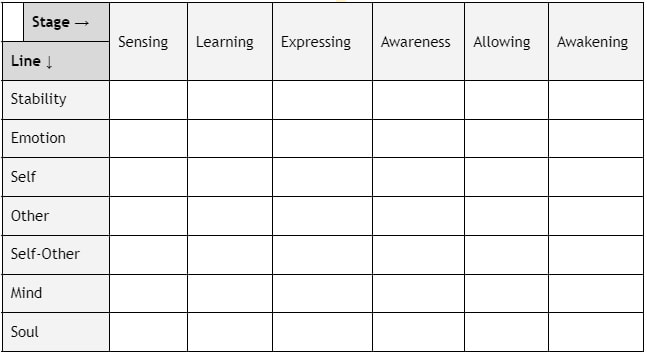
How To Grow
As you read on, try to think about where you are for each line of personal growth so that you’ll know which types of actions to engage in to grow.
Stage 1. We don’t know what we don’t know.
Among our survey participants, 27% are at this stage. Individuals at this stage are unfamiliar with personal growth skills and strategies. Effective personal growth at this stage often involves sensing-based learning (e.g., somatic learning), micro-learning, and basic psychoeducation articles related to any of the lines of personal growth. These actions tend to help us effectively progress through the Sensing and Learning stages of growth (from the earlier model).
Stage 2. We know that we don’t know.
Among our survey participants, 40% are at this stage. Individuals at this stage have learned about some personal growth topics, but they still need help building skills and implementing these strategies in their daily lives. Effective personal growth at this stage often involves simple exercises to practice using the skills. Over time, it is necessary to increasingly focus on applying these learnings in daily life. It is not necessary to focus on a specific line as all lines can benefit from these activities. These actions tend to help us effectively progress through the Learning and Expressing stages of growth (from the earlier model).
Stage 3. We work at what we don’t know.
Among our survey participants, 17% are at this stage. Individuals at this stage already regularly practice well-being-boosting strategies but still have not reached the level of well-being that they seek. Effective personal growth at this stage often involves the need to broaden or deepen one’s skills. For example, if we’ve been focusing on one line (or one thread within one line), we now benefit greatly from building skills related to other, less-developed lines. Or, if we’ve gotten stuck at a particular stage across many lines, we may need to push ourselves outside our comfort zones to take on new perspectives. These actions tend to help us effectively progress through the Awareness and Allowing stages of growth (from the earlier model).
Stage 4. We don’t have to think about it anymore.
Among our survey participants, 16% are at this stage. Individuals at this stage have high well-being. There is always more room for growth, though, and the people taking our survey are still seeking personal growth (which suggests that they haven’t yet reached enlightenment). Effective personal growth at this stage often involves turning inward to learn from deeper parts of the self (e.g., intuition). These actions tend to help us effectively progress through the Allowing and Awakening stages of growth (from the earlier model).

Personal Growth Tips
- Stage 1 (Sensing & Learning Stages). Experience and read. Use your 5 senses and learn as much as you can about what leads to personal growth and well-being.
- Stage 2 (Learning & Expressing Stages). Practice, practice, practice. Start implementing some of the things you learned. Choose activities you like. Maybe you prefer a gratitude list over meditating. Or maybe you prefer to exercise rather than journaling. Start small, add new practices as you progress, and begin using these strategies in your daily life.
- Stage 3 (Awareness & Allowing Stages). Once you have developed a large number of skills and you use them automatically (habitually) in your daily life, start evaluating the areas that need deeper work. The personal growth chart above can be a helpful tool to see which areas need further development. Continue to work on the areas of growth that need more refinement.
- Stage 4 (Allowing & Awakening Stages). You’ll eventually become aware that you’re feeling more whole and connected to all that is. If you don’t resist this integration with oneness, you’ll find that you continue to grow naturally.
Note. You may discover that you are in a similar stage for all lines of growth or that you are in different stages for different lines. As an example, if you are in stage 1 of the Stability line, read about stability topics. And if you are simultaneously in stage 2 of the Mind line, practice exercises related to the mind. If you fall way behind in one line, focus on that line for a while. The most effective personal growth programs will include small and balanced growth in all lines simultaneously.
Examples of Personal Growth
- Joseline decides to spend more time forest bathing—she aims to be fully present and observe nature. This helps her progress in the Awareness stage of her Stability and Soul lines.
- Mark is tired of feeling like everyone walks all over him so he decides to learn about assertive communication. Mark has just exited the Sensing stage and moved into the Learning stage of his Self-Other line.
- Lee has recently been randomly experiencing intense moments of gratitude for all that is. Lee has just entered the Awakening stage of their Other line.
Setting Personal Growth Goals
Example of Setting Personal Growth Goals
As a personal example, I am currently jumping back and forth between the Awareness and Expressing stages of my Self line, which is lagging behind all my other lines. So, I am currently focusing most of my personal growth actions on understanding and expressing my needs, values, and optimal self-expression.
The lack of growth in my Self line has also contributed to slowed growth in my Self-Other line. So for this line, I am working on setting boundaries in relationships and practicing assertive communication.
Personal Growth Challenges
These rapid bursts of growth can indeed be challenging, as each one involves undergoing a loss of some sort. That loss may be of something or someone in our material world, or it may be an identity, belief, or role we have grown attached to. We may feel depressed, tired, or even experience physical symptoms as we progress. It is important that we remember that growth comes in waves, and we will get through this.
Can We Skip Personal Growth Stages?
When we are in each stage, we can not even imagine that the next stage exists (Wilber, 2001). In fact, as soon as we can effectively imagine the next stage, we are in it. So we must go through each stage to create the foundation that supports the next stage.
Future Growth Builds on Past Growth
Here is an example. Theory of Mind is a well-known phenomenon that occurs when a child begins moving from an egocentric perspective to a socio-centric perspective. At first, the child does not understand that other people can have thoughts different from their own. But by age 5 or so, the child’s perspective shifts, and they now understand that each person has their own mind capable of their own thoughts (Carlson et al., 2013).
Later developments along this line enable us to experience empathy—we eventually recognize that people not only have different thoughts from us but that we can understand those thoughts by mentally putting ourselves in their shoes. Empathy then enables us to grow across other lines and threads, for example by improving our relationships and inspiring openness to alternative opinions. This one simple example demonstrates how growth in one area is needed for further growth in that line. It also shows how growth in one line can affect growth in the other lines.
More Examples of How Personal Growth Occurs
Another simple example of how future growth builds on past growth can be seen at the transition from the Awareness stage to the Acceptance stage. Although waves push us back and forth across all the stages, we must have awareness before a wave can roll into acceptance. How could we accept something that we are not aware of?!
The transition from the Allowing stage to the Awakening stage follows the same pattern. As we begin to allow, we open ourselves to possibilities and insights that we previously resisted, avoided, or ignored. Allowing (which includes openness and acceptance) erodes our resistance to the integration of Self (oneness) that emerges during the Awakening stage.
Where Does Personal Growth End?
Personal growth is continuous and is without end. We’re always growing and moving towards something new. However, there is a significant milestone on the personal growth journey that most people (including psychologists) ignore—enlightenment. Given that we can not skip stages and struggle to even imagine the experience we’ll have in the next stages, it is not surprising that enlightenment is rarely considered a milestone of personal growth. Most people have not yet experienced it. So how are they to study it or write about it?
Enlightenment occurs at the end of the Awakening stage, and it is the natural next step once we get to a certain level of personal growth in all of our lines of growth (Wilber, 2001). I assume that there are also personal growth stages after this, but given I can not see beyond where I am (which is the Awakening stage for most of my lines), I can not tell you what they are. (Hopefully one day!)
Personal Growth & Enlightenment
Others suggest that
too much growth in the Mind and Soul lines, along with an underdeveloped Other line, may explain why some spiritual leaders—who are quite advanced in some ways—abuse and manipulate their followers. Needless to say, these are undesirable outcomes and they do not lead to enlightenment.Unbalanced growth patterns may also explain why a large proportion of people who define themselves as spiritual fail to reach enlightenment, or even the advanced stages of growth. These individuals may focus primarily on their Soul or Mind lines—perhaps engaging in third-eye meditation, taking courses on psychic abilities, or seeking to learn manifestation techniques for the purpose of self-aggrandizement.
Of course, none of this is necessary. It may result in “peak experiences”—or momentary entry into the Awakening stage, but an adequate foundation has not been built so the experiences don’t last. Plus, seeking shortcuts often detracts one from reaching the inner peace, joy, and love that they seek. These experiences only become stable when we are in the Allowing and Awakening stages for many lines.
Balanced Personal Growth: The Pathway To Enlightenment?
No particular path—not even a spiritual or religious path—is required to reach enlightenment. It seems that full enlightenment—and the peace, joy, and love that accompanies it—only requires reaching the advanced stages of all the lines. This may explain why many people who do not define themselves as spiritual, and who are not in pursuit of enlightenment in any way (myself included), find themselves in the Awakening stage and approaching enlightenment by accident (Ambrose, 2023).
What Do Advanced Stages of Personal Growth Feel Like?
Here are some experiences that commonly occur during the Awakening stage of personal growth:
Activation of the Clairsenses
It is common for one to report an increase in psychic abilities as they approach enlightenment. Each person’s experience is vastly different and may include a different combination of clairsenses such as clairaudience or clairvoyance (Shutan, 2015).
Physical Symptoms
The body will often start to do weird things at later stages of personal growth. For example, people may have spontaneous movement, headaches, digestive issues, and a variety of unexplainable bodily experiences (Shutan, 2015).
Mental Symptoms
Often, advanced stages of personal growth involve the shedding of knowledge learned in earlier stages. We let go of beliefs, roles, stories, and thoughts that no longer resonate with us. This can result in disorientation and rapid shifts in perception (Shutan, 2015).
Personal Growth Opportunities in Advanced Stages
At every stage of growth, we must grow past the reality we previously knew, and that can be scary (Wilber, 2001). However, earlier stages can be aided by a guide, teacher, or role model— at these stages, we can see how others have grown in the ways we desire and this helps us move forward with less fear. But as we approach enlightenment, we have far fewer role models. The few role models that we do have will often have wildly different experiences than us, forcing us to look inward as a last resort (Soul line) and learn how to trust our intuition (Mind line). At this point, as long as we continue to allow growth and self-integration, we will slowly but surely move toward enlightenment.

Articles Related to Personal Growth
Books Related to Personal Growth
Final Thoughts on Personal Growth
The personal growth journey is different for every single one of us. However, all of us have the potential to end up at a place of inner peace, love, and joy—we can all experience enlightenment. By understanding where we are, where we are going, and how to get there safely, we can be assured of our continued personal growth and evolution.
Don’t Forget to Grab Our Free eBook to Learn How to
Grow Your Wellness Business Exponentially!
References
- Ambrose, Sophia Persephone. (2023). How to Get Through the Dark Night of the Soul: Overcoming Spiritual Depression During Awakening. Nielson UK.
- Bauer, J. J., & McAdams, D. P. (2004). Personal growth in adults’ stories of life transitions. Journal of personality, 72(3), 573-602.
- Carlson, S. M., Koenig, M. A., & Harms, M. B. (2013). Theory of mind. Wiley Interdisciplinary Reviews: Cognitive Science, 4(4), 391-402.
- Kim, J. J., Munroe, M., Feng, Z., Morris, S., Al-Refae, M., Antonacci, R., & Ferrari, M. (2021). Personal growth and well-being in the time of COVID: an exploratory mixed-methods analysis. Frontiers in Psychology, 12, 648060.
- Shutan, Mary Mueller. (2024). Shadow Work for the Soul: Seeing Beauty in the Dark. Findhorn Press.
- Shutan, Mary Mueller. (2015). The Spiritual Awakening Guide: Kundalini, Psychic Abilities, and the Conditioned Layers of Reality. Findhorn Press.
- Tolle, E. (2006). A new earth: Awakening to your life’s purpose. Penguin Life.
- Wikipedia. (n.d.) Four stages of competence. Retrieved 3/19/2024 from https://en.wikipedia.org/wiki/Four_stages_of_competence
- Wilber, K. (2001). The eye of spirit: An integral vision for a world gone slightly mad. Shambhala Publications.
Are You a Therapist, Coach, or Wellness Entrepreneur?
Grab Our Free eBook to Learn How to Grow Your Wellness Business Fast!
