
Bullet Journal Ideas: For Trackers, Mental Health, & More
Find some bullet journal ideas to organize and plan your daily, weekly, and monthly tasks and boost your well-being.
*This page may include affiliate links; that means we earn from qualifying purchases of products. |
The bullet journal system was created by Ryder Carroll, a digital product designer, as a method for increasing productivity and organization. It serves as a fun way to keep track of tasks and progress and people often feel more motivated to use a bullet journal than other standard organization or tracking tools. Read on to learn more about bullet journals and get some ideas. |
Are You a Therapist, Coach, or Wellness Entrepreneur?
Grab Our Free eBook to Learn How to
Grow Your Wellness Business Exponentially!
✓ Save hundreds of hours of time ✓ Earn more $ faster
✓ Boost your credibility ✓ Deliver high-impact content
What Is A Bullet Journal? (A Definition)
It’s called a “bullet journal” because it uses bullet points to represent each task or event. In a bullet journal, you create a table of contents, which you can then use to quickly navigate to different sections of the journal. Each page is divided into two columns, with the left column containing the task or event and the right column containing any notes or additional details. You can also add symbols or “bullets” to the left column to indicate the status of the task or event, such as a dot for a task that has been completed, an arrow for a task that has been migrated to another page, or a star for a task that is a priority.
Uses for a bullet journal
In addition to organizing tasks and events, a bullet journal can also be used for tracking habits, recording ideas, and jotting down notes. Many people find the bullet journal to be a helpful tool for staying organized and reducing stress, as it allows them to clearly see what they need to do and helps them to focus on one task at a time. Bullet journals also help them meet their practical and emotional needs (Ayobi et al., 2018) and some find it deeply satisfying (Wilson, 2018).
Bullet Journal Examples
- Daily planner: Use your bullet journal to schedule your appointments and tasks for the day, as well as any notes or reminders you need.
- Weekly planner: Set up a section in your bullet journal to plan your tasks and appointments for the week, as well as any goals or priorities you have.
- Monthly planner: Create a monthly calendar in your bullet journal to track your appointments and important dates for the month, as well as any long-term goals or projects you are working on.
- Habit tracker: Use your bullet journal to track your daily habits, such as exercise, meditation, or water intake, using checkmarks or tick marks to indicate when you have completed the habit for the day.
- Gratitude log: Use your bullet journal to record things that you are grateful for each day. This can help you focus on the positive aspects of your life and cultivate an attitude of gratitude.
- Budget tracker: Use your bullet journal to track your expenses and create a budget, using different colors or symbols to represent different categories of expenses.
- Project planner: If you have a big project coming up, use your bullet journal to break it down into smaller tasks and track your progress.
These are just a few examples, and you can customize your bullet journal to suit your needs and preferences.

Bullet Journal Ideas for Beginners
- Start with the basics: Set up your bullet journal by creating a table of contents, an index, and a key for your symbols.
- Track your habits: Use your bullet journal to track simple daily habits, such as healthy foods you ate or taking your daily walk. This can help you establish healthy routines and make progress towards your goals.
- Plan your day: Use your bullet journal to schedule appointments, set reminders for tasks, and prioritize your to-do list.
- Reflect on your progress: Use your bullet journal to reflect on your progress towards your goals and to celebrate your accomplishments.
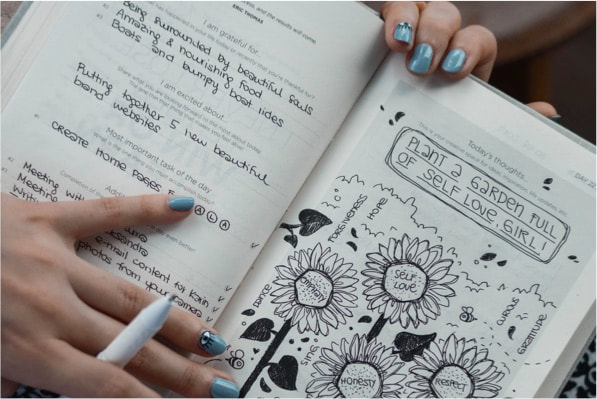
- Get creative: Use your bullet journal as a creative outlet by adding drawings, doodles, or quotes to your pages. This can help you relax and de-stress.
Simple Bullet Journal Ideas
- Set up a calendar: Use your bullet journal to create a monthly calendar where you can track appointments, events, and important dates.
- Make a to-do list: Use your bullet journal to create a daily, weekly, or monthly to-do list. This can help you stay organized and on top of your tasks.
- Track your expenses: Use your bullet journal to keep track of your spending by creating a budget or a financial tracker.
- Keep a self-compassion journal: Use your bullet journal to record kind words to yourself each day. This can help you build a more positive mindset and tone down your inner critic.
- Plan your meals: Use your bullet journal to plan your meals for the week, including grocery lists and recipe ideas.
Bullet Journal Heading Ideas
- To-Do List
- Appointments
- Goals
- Habits
- Projects
- Notes
- Ideas
- Needs
- Gratitude Log
- Budget
- Meal Plan
- Emotion Tracking
- Values
- Favorite Activities
- 10-Year Plan
You can also come up with your own headings that are specific to your needs and interests. For example, you might create a heading for “Books to Read” if you want to keep track of the books you want to read, or a heading for “Travel Plans” if you want to plan future trips. The headings you choose will depend on what you want to track and organize in your bullet journal.

Bullet Journal Ideas for a Mood Tracker
- Set up a monthly mood calendar: On each day of the calendar, record your mood using a simple rating system (such as a scale of 1 to 5). You can also use different colors or symbols to represent different moods.
- Use a key: Create a key that explains the different moods you are tracking. For example, you might use green for “happy,” yellow for “neutral,” and red for “sad.”
- Add notes: Along with your mood rating, you can also add notes about what happened that day or what might have contributed to your mood. This can help you identify patterns or triggers for your moods.
- Track other things that affect your mood: In addition to tracking your mood, you can also use your bullet journal to record things that you think might affect your mood, things such as exercise, diet, seeing friends, or even creativity. I did this once and it turned out that creativity had the biggest positive impact on my mood. So you never know what you might discover.
- Reflect on your progress: As you track your mood over time, you can use your bullet journal to reflect on your progress and identify any trends or patterns. This can help you understand your moods and find ways to improve your well-being.
Bullet Journal Ideas for a Habit Tracker
- Create a list of habits: Write down the habits you want to track, such as time spent on your goals, time spent in nature, or reading.
- Set up a habit tracker: Use your bullet journal to create a grid with each habit you want to track. Then check off when you do or do not complete each habit.
- Make it visually appealing: Use colors, drawings, or stickers to make your habit tracker more visually appealing. This can help make tracking your habits more enjoyable.
- Reflect on your progress: As you track your habits over time, use your bullet journal to reflect on your progress and identify any trends or patterns. This can help you understand your habits and find ways to improve them.
Video: New Bullet Journal Ideas
Minimalist Bullet Journal Ideas
- Keep it simple: Use minimal text and design elements in your bullet journal to create a clean, uncluttered look.
- Use a limited color palette: Choose a few colors that you will use consistently throughout your bullet journal, and stick to those colors to create a cohesive look.
- Use grids or lines: Instead of creating elaborate spreads, use grids or lines to create simple, structured layouts for your pages.
- Be selective with your content: Choose the most important tasks, events, and notes to include in your bullet journal, and leave out anything that is not essential.
- Use negative space: Embrace white space by leaving plenty of room between your bullet points and other elements. This can help create a sense of calm and clarity in your bullet journal.
Bullet Journal Box Ideas
- List of items you’d like to purchase (e.g., books, kitchen items, things for your desk, etc…)
- Favorite foods list
- Your strengths and weaknesses
- List of things you love about your friends and family
- Favorite self-care activities or relaxation techniques
Bullet Journal Ideas for Mental Health
- Record your thoughts and feelings: Use your bullet journal as a journal to write down your thoughts and feelings. This can be a helpful outlet for processing your emotions and managing stress. Writing about emotional experiences for 15-30 minutes per day has been shown to result in improvements in mental and physical health (Pennebaker, 1997).
- Focus on the positive things: By making lists of good things in our lives or qualities that we like in ourselves, we can help undo some of our negative emotions.
- Seek professional help: If you are struggling with your mental health, it is important to seek professional help. Use your bullet journal to record appointments with therapists or other mental health professionals, and to keep track of any treatment plans or recommendations.
Bullet Journal Ideas for Self-Care
- Make a self-care to-do list: Use your bullet journal to create a daily, weekly, or monthly self-care to-do list, including activities such as physical exercise, self-care activities, or hobbies.
- Create a self-care routine: Use your bullet journal to plan and schedule your self-care activities, so that you can make self-care a regular part of your routine.
- Reflect on your self-care: Use your bullet journal to reflect on the impact of your self-care activities on your well-being, and to identify any changes or adjustments that you might want to make.
- Practice mindfulness: Use your bullet journal to practice mindfulness techniques, such as mindful journaling or mindful breathing exercises. This can help you reduce stress and improve your overall well-being.
Is Bullet Journaling Worth It?

Articles Related to Bullet Journal Ideas
Books Related to Bullet Journal Ideas
Final Thoughts Bullet Journal Ideas
You can also use your bullet journal to track your habits, record your ideas, and jot down notes. Many people find bullet journaling really helpful for staying organized and reducing stress because it gives them a clear overview of what they need to do and helps them focus on one thing at a time. But bullet journaling might not be for everyone, so think about your own needs and preferences before you decide if it’s worth your time and effort.
Don’t Forget to Grab Our Free eBook to Learn How to
Grow Your Wellness Business Exponentially!
References
- Ayobi, A., Sonne, T., Marshall, P., & Cox, A. L. (2018, April). Flexible and mindful self-tracking: Design implications from paper bullet journals. In Proceedings of the 2018 CHI conference on human factors in computing systems (pp. 1-14).
- Pennebaker, J. W. (1997). Writing about emotional experiences as a therapeutic process. Psychological science, 8(3), 162-166.
- Tholander, J., & Normark, M. (2020, April). Crafting Personal Information-Resistance, Imperfection, and Self-Creation in Bullet Journaling. In Proceedings of the 2020 CHI Conference on Human Factors in Computing Systems (pp. 1-13).
- Wilson, E. (2018). Planning for professional productivity with bullet journals. Journal of New Librarianship, 3(2), 220-223.
Are You a Therapist, Coach, or Wellness Entrepreneur?
Grab Our Free eBook to Learn How to Grow Your Wellness Business Fast!
