
Mind Mapping: Definition & Examples in Psychology
Mind mapping is a powerful technique for organizing our thoughts. Learn more about what mind mapping is and how it might benefit you.

*This page may include affiliate links; that means we earn from qualifying purchases of products. |
Humans are an extremely visual species. In other words, vision (for seeing people) is central to our ability to effectively engage with and move through our world. In fact, we have approximately 5 billion neurons that are specifically dedicated to processing visual information (Wandell et al., 2007). |
Before reading on, if you’re a therapist, coach, or wellness entrepreneur, be sure to grab our free
Wellness Business Growth eBook to get expert tips and free resources that will help you grow your business exponentially.Are You a Therapist, Coach, or Wellness Entrepreneur?
Grab Our Free eBook to Learn How to
Grow Your Wellness Business Exponentially!
✓ Save hundreds of hours of time ✓ Earn more $ faster
✓ Boost your credibility ✓ Deliver high-impact content
What Is Mind Mapping? (A Definition)
Mind mapping is a technique through which you develop and visually organize thoughts, ideas, and information. This technique involves identifying a central topic (often represented as an image) and creating branches indicating the relevant categories that are related to the central topic extending radially from the central idea (Budd, 2004).
A mind map essentially provides a scaffold that helps structure complex concepts and allows for a better understanding of the relationship between concepts (Zhao et al., 2022). In other words, a mind map allows you to take advantage of the vast neural real estate dedicated to visual processing and leverage it for breaking down complex topics into digestible or actionable bits.
Mind Mapping in Psychology
Psychological research has shown that mind mapping is an excellent tool for enhancing learning and understanding. For example, in a sample of 120 8th-grade students, researchers found that students who were taught using a mind mapping technique performed better on a subsequent test than students who were taught using traditional methods (Parikh, 2016). Other studies have found similar results. For example, a study involving college freshmen taking a writing class showed that students who were taught to use mind maps to organize their ideas made greater improvements in their writing ability than students who were taught to organize their ideas using traditional methods (Al-Jarf, 2009).

Mind Mapping Benefits
Mind maps have also been shown to improve the following skills:
How To Do Mind Mapping
1. Define your central topic
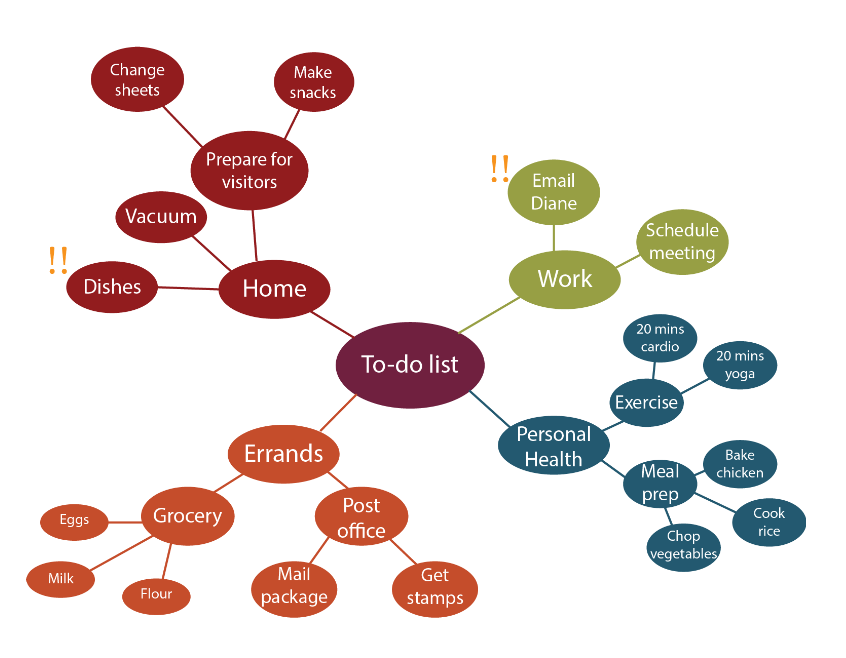
First, consider what the focus of your mind map should be and write it out in the center of the page. For example, if you are mind mapping out a to-do list, you would simply write “to-do list”.
2. Identify your first-level concepts or topics
Next, consider the broader categories that are related to your central topic. These categories will become the first nodes branching off from the central point of your mind map. Sticking with the to-do list example, your first-level categories might include home, work, errands, and personal health.
3. Expand your branches
Each of the first-level categories you defined previously will branch off into different sub-categories, or second-level categories. For example, branches from the first-level category “home” might include cleaning and preparing for visitors. Each of these second-level categories might also have branches. For example, the category “cleaning” might include vacuuming, laundry, and dishes, and the category “preparing for visitors” might include changing the sheets and making snacks. Each branch can expand as many times as necessary.
4. Add images or annotations
Many people find it helpful to include images that represent different categories or different levels of priority. Using annotations or different colored pens when creating your mind map can also be a helpful way to indicate urgency or to set your different categories apart.
Mind Mapping Examples
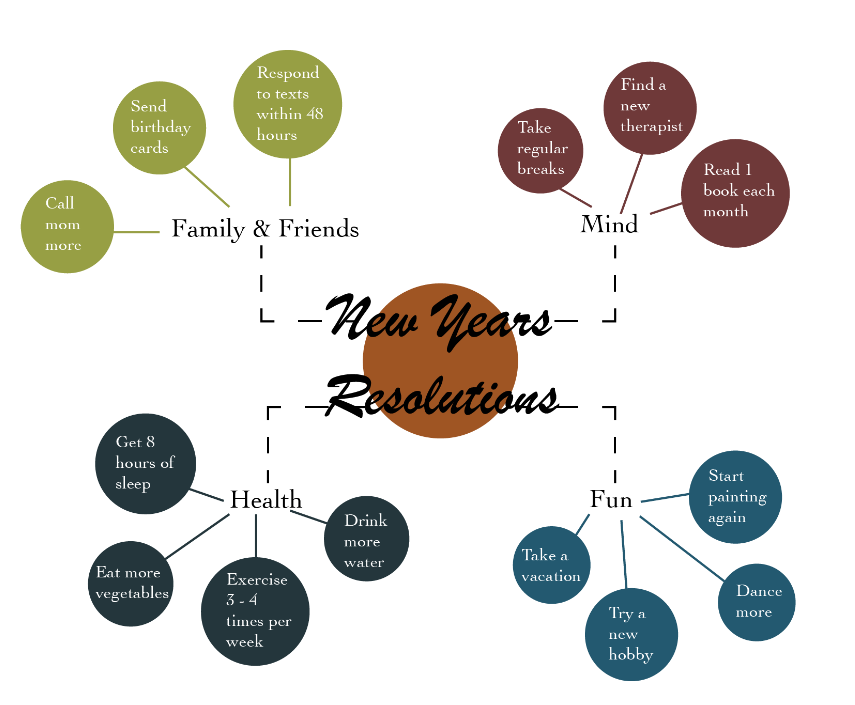
The style, structure, and content of a mind map can vary almost infinitely. Any concept can be mapped and there are many forms each map can take. Most mind maps have the main topic located centrally with different categories branching out radially, but they don’t necessarily need to follow this structure. For example, some mind maps might look more like a tree, with the primary concept at the bottom and each category branching upward. Other mind maps might look more like one side of a competition bracket, with each level of categories branching horizontally out from the primary concept. Below are just a couple of examples of mind maps to help inspire you as you create your own maps. When it comes to any maps that you create, however, make them in whatever fashion works best for you and the topic you are mapping.
Mind Mapping for Goals
Research shows that clearly identifying your sub-goals actually makes attaining your goal less difficult, enhances your perception of how attainable your goal is, and provides positive reinforcement which facilitates continued motivation and persistence (Latham & Seijts, 1999).
Mind mapping for goals is similar to creating mind maps for anything else. The first step is to succinctly describe your goal and write it down in the center of your page. Then identify all the component parts that go into achieving that goal. For example, if your primary goal is to start a business, one of your sub-goals might be creating strategies for marketing your product or service. Write out all your sub-goals as nodes that branch off your main goal. Then you’ll do this again for each sub-goal and so on until you have identified all the steps that will be necessary for achieving your goal.
Mind Mapping Yourself
Mind mapping yourself can be a really effective tool for personal growth because it allows you to visualize your current strengths as well as the areas in which you’d like to improve. Understanding the strengths you already have is necessary for knowing when and how to apply them to facilitate growth. If using this technique for personal growth, you can start by asking yourself questions like these:

Mind Mapping for Mental Health
When mind mapping our emotions, we can start with the primary question we are investigating – how am I feeling?
- Our first branch can be either the emotion we’ve identified, such as anger or jealousy, or the event that triggered the emotion if we are already aware of what it was.
- Next, take time to reflect on this first branch. Are there specific factors that stand out? Can you identify any additional, related emotions that you are feeling? Are there different ways to describe the feeling or metaphors that would provide a helpful description? Does this feeling or event remind you of any past experiences?
- After we’ve thoroughly analyzed our first branch and recorded everything that came up for us as a second level of branches, we can repeat these questions for each branch at each level until we feel that we have a richer understanding of what we are feeling and why.
Mind Mapping Tools
Mind Map with Pen and Paper
Pen and paper are easily accessible and provide ample flexibility in how your maps are structured. You can keep them simple with just a single pen and notebook paper, or you can get creative with different colored pencils, pens, stickers, and drawings. It might be helpful to get erasable pens if possible, in case you decide to reorganize some aspects of your map.
Mind Map with Software
Computer software can be a great tool for mind mapping because it allows you to organize a vast amount of information in one convenient place. Here are a few options for mind mapping software:
- FreeMind
- 3D Topicscape
- Aviz Thought Mapper
- Axon Idea Processor
- BrainMine
- Bubble-Mind
- Creately
- ConceptDraw MINDMAP
- iMindQ
Mind Map with Apps
Like computer software, apps allow you to store large amounts of information in one place, but with the added convenience of your mind maps being easily accessible on your phone or tablet. Below are a few options for mind mapping apps:
- GitMind Mind Map
- Mindomo
- MindMeister
- FreeMind
- Mindly
- XMind: Mind Map
- Coggle
- Lucidchart
- Mindjet Maps
Mind Mapping Exercises
Practicing mind mapping is easy. All you have to do is pick a topic and start mapping. It might be helpful to start with a topic that is not of great significance to you when you are practicing so as to remove any undue pressure to get it exactly right. Write or illustrate your topic in the center of your page or in any of the apps or software previously mentioned and write out the first few things that come to mind when you consider your chosen topic. For example, if your primary topic is food, the first things to come to mind might be the basic food groups – fruits, vegetables, grains, proteins, and dairy. Next, consider each category individually and write out everything that comes to mind and proceed with this process until you are all out of ideas.

Articles Related to Mind Mapping
Books Related to Mind Mapping
Final Thoughts on Mind Mapping
For more on what a mind map is, check out this video:
Video: Mind Maps Tutorial
Don’t Forget to Grab Our Free eBook to Learn How to
Grow Your Wellness Business Exponentially!
References
- Latham, G. P., & Seijts, G. H. (1999). The effects of proximal and distal goals on performance on a moderately complex task. Journal of Organizational Behavior: The International Journal of Industrial, Occupational and Organizational Psychology and Behavior, 20(4), 421-429.
- Oettingen, G., & Gollwitzer, P. (2010). Strategies of setting and implementing goals: Mental contrasting and implementation intentions.
- Parikh, N. D. (2016). Effectiveness of teaching through mind mapping technique. The International Journal of Indian Psychology, 3(3), 148-156.
- Wandell, B. A., Dumoulin, S. O., & Brewer, A. A. (2007). Visual field maps in human cortex. Neuron, 56(2), 366-383.
- Zhao, L., Liu, X., Wang, C., & Su, Y. S. (2022). Effect of different mind mapping approaches on primary school students’ computational thinking skills during visual programming learning. Computers & Education, 181, 104445.
Are You a Therapist, Coach, or Wellness Entrepreneur?
Grab Our Free eBook to Learn How to Grow Your Wellness Business Fast!
