
Emotion: Definition, Theories, & Examples
What is emotion and why is it important? Here we look at emotion theories, emotional concepts, lists of emotions, emotional intelligence, and emotion regulation.

*This page may include affiliate links; that means I earn from qualifying purchases of products.
Emotions are central to what it means to be human. We feel deeply, and those emotions often lead us to do things. Emotions are also a key ingredient in well-being. It’s hard to imagine well-being without happiness. And emotions like sadness and anxiety can make well-being more difficult to achieve. Some might even use the words happiness and well-being interchangeably. So let’s learn more about emotions and their role in our lives.
Are You a Therapist, Coach, or Wellness Entrepreneur?
Grab Our Free eBook to Learn How to
Grow Your Wellness Business Exponentially!
✓ Save hundreds of hours of time ✓ Earn more $ faster
✓ Boost your credibility ✓ Deliver high-impact content
What Is Emotion? (Emotion Defined)
Nevertheless, most seem to agree that emotions are functional. For example, they prepare us to respond to a perceived or real environmental stimulus (e.g., being chased by a mountain lion or being rejected by a friend). In this case, we may experience fear and it causes us to retreat.
Video: Emotion: Definition, Theories, & Examples
Do you prefer to learn about emotion from a video? You can watch the video version of this entire article below:
Emotions differ from moods in that emotions typically last minutes to seconds whereas moods can last hours or days. So if we said, “I’m feeling down”, that’s referring to a mood. But if we say, “I’m sad that Mark didn’t show up to dinner,” we’re referring to an emotion. Of course, emotions can contribute to moods and moods can contribute to emotions. So there may be some overlap.
Emotion versus thought
Of course, thoughts and emotions are different things but they overlap both in terms of experience and in the ways that we talk about them. For example, we can’t experience an emotion like regret without evaluating something that we’ve done (i.e., thinking about it) and judging it to be bad or the wrong thing. Many emotions work this way in that they would not exist if not for the thoughts that created them.
Similarly, many of the words we use to describe our experiences are a mixture of thoughts and emotions. For example, words like brooding, resentful, or disturbed are probably a combination of thoughts and emotions.
Emotion versus feeling
We also tend to use the word ‘feeling’ interchangeably with emotion, even though feelings and emotions are not the same things. Feelings include both emotional experiences and physical sensations. For example, we might say we’re feeling hungry, feeling tired, or feeling itchy even though these are not emotions. But we can also feel emotions—for example, we may feel upset, angry, or sad.
All of this makes emotion a very complex thing to talk about and understand. But let’s keep exploring it because emotion is such an important part of life and well-being.

Emotion Theory
The discrete theory of emotion
The most well-known of these theories is the discrete theory of emotion. This theory suggests that emotions are separate, discrete things that we developed from having to deal with fundamental life tasks like running away from a predator (Ekman, 1999).
According to the discrete theory of emotion, there are 5-6 basic emotions and all other emotions are just varying shades or combinations of these basic emotions. The basic emotions are:
The circumplex model of emotion
Other emotion theorists have argued that emotions are not discrete things. They note that emotions don’t have specific locations in the brain, multiple emotions tend to arise at the same time, and there are many blends of emotions. These findings suggest that we may use specific words to describe specific emotions, but that emotions may not be discrete things. They may instead exist on a continuum (Russell, 1980).
The Emotion Circumplex Model suggests that emotions can be mapped on two continuums: one is from high to low energy; the other is from high to low pleasure. So an emotion like sadness would be low energy and low pleasure while an emotion like anger would be high energy and low pleasure. This model also accounts for the fact the emotions are not always the same intensity. For example, we might feel a little scared, a lot of fear, or downright terrified.
The wheel of emotion
Another well-known emotion theory is Plutchik’s emotion wheel. This theory suggests that there are primary, secondary, and tertiary emotions. Each of the emotions in the wheel can then be combined in specific ways to create new emotions.
Why do emotion theories matter?
For the average person, knowing exactly what emotions are may not necessary for well-being. But understanding your own emotions—what causes them, how you experience them, and how you regulate them—are important skills. So let’s dive into a bit more of the practical knowledge we need to improve our emotional health.

Emotional Intelligence
Emotional intelligence is a type of intelligence that is defined as the ability to monitor and regulate one’s own and others’ emotions and to use emotions to facilitate one’s thoughts and actions (Brackett, Rivers, & Salovey, 2011). It’s generally broken up into the following four parts:
The four-part theory of emotional intelligence
Emotion perception. This involves the ability to correctly perceive emotions including facial expressions, body language, and tone of voice.
Emotion facilitation of thought. This involves the ability to use one‘s emotions to aid problem solving.
Emotion understanding. This involves understanding emotions, including the way that emotions change over time, the causes and consequences of emotions, and how emotions may blend together.
Emotion regulation. This involves the management of one‘s own and other‘s emotions and usually involves the up-regulation of positive emotions and down-regulation of negative emotions (Elfenbein & MacCann, 2017).
Each of these aspects of emotional intelligence—or emotional skills—generally help us navigate the world more effectively. So let’s dive into each of them a bit more.
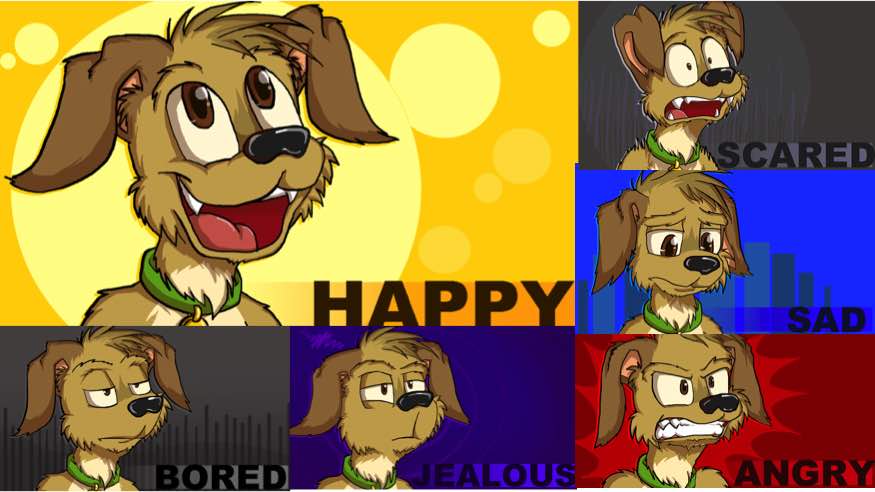
Emotion Perception
|
Emotion faces are often used to help kids (and individuals with autism) learn how to recognize different emotional expressions. For example, my puppy card set can help kids improve emotional perception.
|
|
Emotion Facilitation of Thought
Another example may be that we’ve just said something that leads someone else to appear hurt or sad. First, we need to perceive this emotion in the other person, and then we need to use the emotion to help us learn something about how our behavior affects other people. We can use the emotion to teach us how not to hurt others.
Emotion Understanding
Emotion Regulation (And Emotion Dysregulation)
Then we might then choose situations and actions that make us feel good and avoid those that make us feel bad. So, for example, we might go to the gym because we know we’ll feel better afterward. And we might stop seeing a particular friend who always puts us down and makes us feel sad. Or, if we’re emotionally dysregulated, we might drink alcohol or do drugs to regulate our emotions, but we’re likely to end up feeling worse later on.
Next, we might regulate our emotions with cognitive strategies (sometimes referred to as emotion regulation skills). We might use reappraisal to find the silver linings. Or we might savor a positive moment to increase how long our positive emotions last. Or, if we’re dysregulated, we might worry about the future and accidentally increase our anxiety.
Video: Emotion Regulation: Definition & Strategies
Negative Emotion
When we think about emotion, we often focus mostly on negative emotions. Negative emotions are unpleasant or undesirable states. Even though we may not like negative emotions, they help us do important things in our lives. For example, fear can help us escape from a predator, anger can help us right injustices, and sadness can help us rest or seek social support. This just shows that we need negative emotions just as much as we need positive emotions.

Positive Emotion
Happiness may be the best-known positive emotion, but there are lots of others. Here are some other positive emotions.
A List of Emotions
Need some help identifying your emotions? Here is a list of all the emotions we could find:
Video: How to Process Your Emotions
Emotion Contagion
Some researchers suggest we might reduce emotional contagion by alternating between moments of self-awareness and moments of other awareness (Hatfield, Cacioppo, & Rapson, 1993). For example, if we’re starting to feel anxious but can’t identify any clear cause, we might try to turn on our emotion perception to see if we’re ‘catching’ anxiety from someone we’re interacting with. Then we might aim to become more present in our body and help the other person regulate their emotions to reduce our negative emotions.
Emotional Health
Ultimately, emotional health arises from positive health behaviors—things like being skilled at health emotion regulation and engaging in other healthy behaviors that make emotions easier to manage or regulate. For example, good sleep, a good diet, and regular exercise all make it easier for us to regulate our emotions. Emotional health and physical health really do go hand-in-hand and work together.
Emotion Activities
Articles on Specific Emotions
Books on Emotions
Don’t Forget to Grab Our Free eBook to Learn How to
Grow Your Wellness Business Exponentially!
References
- Brackett, M. A., Rivers, S. E., & Salovey, P. (2011). Emotional intelligence: Implications for personal, social, academic, and workplace success. Social and personality psychology compass, 5(1), 88-103.
- Ekman, P. (1999). Basic emotions. Handbook of cognition and emotion, 98(45-60), 16.
- Elfenbein, H. A., & MacCann, C. (2017). A closer look at ability emotional intelligence (EI): What are its component parts, and how do they relate to each other?. Social and Personality Psychology Compass, 11(7), e12324.
- Fan, R., Xu, K., & Zhao, J. (2018). An agent-based model for emotion contagion and competition in online social media. Physica a: statistical mechanics and its applications, 495, 245-259.
- Gendron, M. (2010). Defining emotion: A brief history. Emotion Review, 2(4), 371-372.
- Hatfield, E., Cacioppo, J. T., & Rapson, R. L. (1993). Emotional contagion. Current directions in psychological science, 2(3), 96-100.
- Hendrie, H. C., Albert, M. S., Butters, M. A., Gao, S., Knopman, D. S., Launer, L. J., … & Wagster, M. V. (2006). The NIH cognitive and emotional health project: report of the critical evaluation study committee. Alzheimer’s & Dementia, 2(1), 12-32.
- Russell, J. A. (1980). A circumplex model of affect. Journal of personality and social psychology, 39(6), 1161.
Are You a Therapist, Coach, or Wellness Entrepreneur?
Grab Our Free eBook to Learn How to Grow Your Wellness Business Fast!
