
Intuition: Definition, Examples, & Quotes
Learn how to listen to your inner voice and intuition. Explore intuition exercises, quotes, and more.
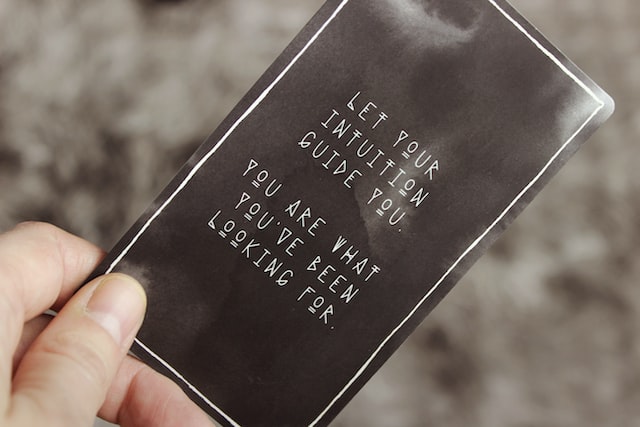
*This page may include affiliate links; that means we earn from qualifying purchases of products. |
Have you ever instantly understood something without needing to think about it? Some people might describe this as a “gut feeling”. This gut feeling–or intuition–is one way that we as humans process information in our environment. This article will help you understand what intuition is and provide you with exercises to connect to your intuition. |
Are You a Therapist, Coach, or Wellness Entrepreneur?
Grab Our Free eBook to Learn How to
Grow Your Wellness Business Exponentially!
✓ Save hundreds of hours of time ✓ Earn more $ faster
✓ Boost your credibility ✓ Deliver high-impact content
What Is Intuition? (A Definition)
Intuition usually comes to you in an instant. All at once, you understand what you need to do or what the answer to the question is. Often you can’t explain why you feel that way, you just do.
Examples of intuition:
- Feeling like you have a “pit” in your stomach when you have to make a hard decision
- “Light bulb” moments where you understand something or get a good idea out of nowhere
- Reading non-verbal communication cues to understand what people are saying between the lines
You can use your intuition to make decisions in situations where analytical thinking alone isn’t enough. Sometimes connecting to your intuition and making a decision based on how you feel is the best way forward.
Video: Intuition Is Your Superpower: The Green Light to Your Destiny
What Is Intuition in Psychology? (A Definition)
Intuition is a hotly debated concept in the psychology field. This is because it is hard to measure and hard to define. Of particular interest are the biases that can come with following your intuition. Intuition plays a large role in how we interpret data. As one article states, “intuitions constructed from a lifetime of experience are not dismissed easily” and “intuitions can foster or hinder theoretical progress in a scientific discipline” (Cacioppo, 2004). It is a delicate balance to follow one’s intuition while also being aware of the biases that might come along with it.
Intuition vs Instinct
Humans have developed several collective instincts that have helped us survive in harsh environments. While every person does not necessarily possess these instincts, they have been found across large groups of people. In fact, “evolutionary psychologists have shown that we are no different from other animal species in possessing a wide range of instincts that have promoted the evolutionary success of our species” (MacLennan, 2006).
Common Human Instincts:
- Tribal loyalty
- Urge towards procreation
- Self-preservation
- Greed
- Seeking meaning

Intuition vs Sensing
You perceive the world around you through your senses which include smell, taste, sight, hearing, and touch. Movement and balance also allow you to keep track of where your body is in space. Sensing is when you take in all of the information in your environment and intuition is how you interpret that information. Focus on the information generated by your senses and how that makes you feel. Is there a good smell that makes you feel warm and fuzzy inside? Or do you hear something that makes your skin crawl? Paying keen attention to your senses can help you follow your intuition.
Video: Sensing vs Intuition – Carl Jung
Intuition vs Anxiety
Intuition vs Logic
Many times, intuition goes against logic. It can be hard to explain why you feel the way you do. For example, you might be in a situation where you have to make a choice. Choice “A” is the logical, practical choice and it would make the most sense to choose this one. However, maybe your heart is pulling you towards Choice “B” for reasons you can’t explain. Even though Choice “A” makes more sense logically, Choice “B” is the option you choose because it makes you feel true and warm inside.
Opposite of Intuition

Examples of Intuition
- Lauren is about to graduate from high school and needs to make some decisions about her future. She is either going to head straight to college or join the military. After some consideration, she decides to join the military because to her “it just feels like the right choice”. This choice allows her the opportunity to travel the world, learn useful life skills, and help pay for college once she completes her contract. Following her “gut” turned out to be a good decision.
- Manuel works at the mall downtown. He is working late one night and sees the parking lot is almost empty with one car parked next to his. He gets a bad feeling and asks security to escort him to his car. He feels good that he followed his intuition and avoided a possibly dangerous situation.
Intuition Exercises
Intuition Exercise: Trust Yourself
- Sit comfortably and get in touch with your breath. Count “1” and inhale then count “2” and exhale. Repeat this until you feel relaxed.
- Identify a situation you need further insight into and focus on all of the details of the problem.
- Pay attention to how your body responds. Positive situations usually manifest positive bodily feelings and the same is true for negative situations and feelings.
- Make a decision about the situation based on your bodily reactions. Try to trust yourself and know that your gut is leading you in the right direction.
Intuition Exercise: Adventure Time
- Make a date with yourself on your calendar. Allow at least 2-3 hours.
- When the day comes, get in your car–or hop on public transportation–without a plan.
- Resist the urge to control the situation. Relax your body until you get a flash of intuition about what to do on your adventure day.
- Try not to think too much, allow your day to unfold, and enjoy the adventure your intuition creates.
Video: The Power of Intuition
Video: How to Connect With Intuition
What’s Intuitive Eating?
People who practice intuitive eating may experience a number of both physical and psychological benefits (Van Dyke & Drinkwater, 2013).
Benefits of Intuitive Eating:
Practicing intuitive eating requires you to be more in tune with your body. The concept behind this method states that you can trust your body to know the type and quantity of food you need to eat to maintain an appropriate weight. The four points of the Intuitive Eating Model in psychology are as follows (Hawks et al., 2004):
- Intrinsic eating cues: the ability to recognize the physical signs of hunger, satisfaction, and fullness.
- Extrinsic eating cues: consideration of a full range of food possibilities and eating what one wants.
- Anti-dieting: appreciation of food and paying attention to the physical effects of eating.
- Self-care: valuation of health and energy more than appearance.
How to Practice Intuitive Eating
Eating in front of the TV or while scrolling through your phone prevents you from listening to your bodily cues while eating. Try turning off the distractions and just focusing on eating when mealtime rolls around.
2. Connect with your body
When you are eating, try to immerse yourself in the experience fully. What textures does your meal have? How does the food smell? Do you feel full halfway through or does your body need to eat the whole meal? Practicing guided meditation is a good tool to help reconnect your mind and body.
3. Make meals you enjoy
You don’t have to force yourself to eat foods you don’t like just because they are “healthy”. Try identifying a variety of meals that both fulfill your dietary needs and satiate your cravings.
4. Don’t punish yourself
If you are not used to eating mindfully, it can take some time to adjust to intuitive eating. Try to be kind to yourself if you eat more than you intend to or eat foods that don’t make you feel good. Each time you have a meal is a chance to practice better intuitive eating skills.
Intuition Quotes
- “Instinct is untaught ability.” — Bain
- “It’s your own intuition, combined with your experience and judgment, that can really guide you forward.” — Berrak Sarikaya.
- “Trust your hunches. They’re usually based on facts filed away just below the conscious level.” — Joyce Brother.
- “Everyone who wills can hear the inner voice. It is within everyone.” — Mahatma Gandhi.
- “Intuition is the compass of the soul.” — Anonymous
- ”Trusting your intuition means tuning in as deeply as you can to the energy you feel, following that energy moment to moment, trusting that it will lead you where you want to go and bring you everything you desire.” — Shakti Gawain
- “Have the courage to follow your heart and intuition. They somehow already know what you truly want to become. Everything else is secondary. ”— Steve Jobs
- “At times, you have to leave the city of your comfort and go into the wilderness of your intuition. What you’ll discover will be wonderful. What you’ll discover is yourself.” ― Alan Alda

Articles Related to Intuition
Books Related to Intuition
Final Thoughts on Intuition
Intuition can be a difficult concept to define. It is usually a very different experience for different people. Some common phrases people use when following their intuition include “I had a gut feeling” or “I am following my heart”. These expressions demonstrate that intuition is usually a feeling you experience in your body. When you follow your intuition, it might feel like you are being pulled towards a decision or situation, even if you can’t explain why. Some people are very in touch with their intuition and find it easy to follow their desires. Others may struggle with connecting to their intuition which might lead to feelings of confusion and overwhelm. Try incorporating the exercises in this article or intuitive eating into your life to help reconnect to your intuition.
Don’t Forget to Grab Our Free eBook to Learn How to
Grow Your Wellness Business Exponentially!
References
- Cacioppo, J. T. (2004). Common sense, intuition, and theory in personality and Social Psychology. Personality and Social Psychology Review, 8(2), 114–122.
- Hawks, S., Merrill, R. M., & Madanat, H. N. (2004). The intuitive eating scale: Development and preliminary validation. American Journal of Health Education, 35(2), 90–99.
- MacLennan, B. J. (2006). Evolutionary Jungian psychology. Psychological Perspectives, 49(1), 9–28.
- Van Dyke, N., & Drinkwater, E. J. (2013). Review article relationships between Intuitive Eating and Health Indicators: Literature Review. Public Health Nutrition, 17(8), 1757–1766.
Are You a Therapist, Coach, or Wellness Entrepreneur?
Grab Our Free eBook to Learn How to Grow Your Wellness Business Fast!
