
Maslow’s Hierarchy of Needs: Definition, Examples & Explanation
Maslow’s hierarchy of needs describes why we pursue one of our needs over another. Read on to see the uses – and limitations – of this fundamental psychology theory.

*This page may include affiliate links; that means we earn from qualifying purchases of products. |
Have you ever heard of Maslow’s hierarchy of needs? Perhaps it came up in an introductory psychology course you took or a popular media article on some topic in the social sciences that you read. Maslow’s idea that some human needs are more pressing than others, and that we can use this knowledge to understand what motivates human behavior, has influenced many researchers and healthcare providers. |
Before reading on, if you’re a therapist, coach, or wellness entrepreneur, be sure to grab our free Wellness Business Growth eBook to get expert tips and free resources that will help you grow your business exponentially.
Are You a Therapist, Coach, or Wellness Entrepreneur?
Grab Our Free eBook to Learn How to
Grow Your Wellness Business Exponentially!
✓ Save hundreds of hours of time ✓ Earn more $ faster
✓ Boost your credibility ✓ Deliver high-impact content
What Is Maslow’s Hierarchy of Needs? (A Definition)
Maslow studied both human and animal behavior, allowing him insight into both complex and very basic needs. In creating his hierarchy, Maslow (1943, 1954) first divided human needs into five categories: physiological needs, safety and security, love and belonging, self-esteem, and self-actualization. He then proposed that these needs could be ranked by how important or basic to human functioning they were (see the pyramid below). Finally, Maslow proposed that our ability to have these needs met would impact our psychological health. Specifically, he thought that our psychological health would be most negatively impacted by not being able to meet the more fundamental needs towards the bottom of the pyramid.
List of Maslow’s Hierarchy of Needs (From Most Basic to Most Advanced)
I. Physiological Needs. These are the things that most, if not all, organisms need to survive, such as the ability to breathe, stay warm enough or cool enough, get sleep when we need it, and have enough food and water to survive.
II. Safety and Security. The second set of needs provides for our safety and security. This includes being physically healthy and having the physical and interpersonal resources we need to survive, such as a home to live in. For children, this means having a reliable caregiver that keeps them healthy and provides for their physiological needs.
III. Love and Belonging. Once safety and security are established, we focus on feeling connected to others, such as having a romantic partner and friends in our lives.
IV. Self-Esteem. Nearing the top of the hierarchy, our needs become centered on feeling good about ourselves. Are we recognized and respected for our contributions? Do people seem to like us for who we are or what we’re good at? We take these cues from other people and use them to support our positive beliefs about ourselves.
|
V. Self-Actualization. The most advanced need Maslow describes is that of being engaged in meaningful activities that align with our values and express who we are. Imagine a highly-paid and successful lawyer who does not find her work personally meaningful or believe in its purpose. Although all her other needs might be met, she likely would not feel she is self-actualized.
|
Focus Music for Work & Study
|
Maslow’s Hierarchy of Needs Pyramid
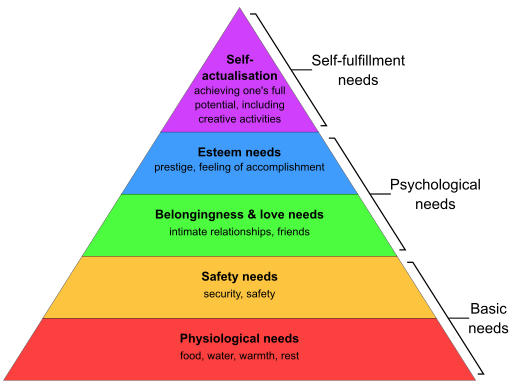
Maslow’s Hierarchy of Needs Explained
Maslow characterized the next level of needs as being related to safety and security, and he stressed that without these needs being met, we would start having trouble meeting our physiological needs. Maslow used the example of a child or infant’s experience to make this hierarchy clear: without access to a reliable caregiver, a child is unlikely to feel safe, and more likely to lack the food, shelter, and clothing they need.
Once people feel safe, Maslow reasoned, they next focus on belonging and love. Maslow observed that people who did not feel that they belong – who do not feel loved – are much more likely to have psychological issues, such as depression, anxiety, or addiction. These psychological issues, in turn, make it harder to meet our needs for safety.
While being loved and knowing we belong is meaningful to us, the higher-order need that builds on this need is our desire to be seen as good for who we are and what we do. This meets our need for self-esteem and self-respect.
When all other needs are met, Maslow argued that we focus on doing the things that best suit us, that give us the most self-fulfillment. He called this self-actualization. While other needs look fairly similar from one person to the next, Maslow thought that this last need would be unique to each individual: only you can know what experiences will be most fulfilling for you.
Video: Maslow & Self-Actualization
Examples of Maslow’s Hierarchy of Needs
Maslow’s Hierarchy of Needs Real Life Examples
A common critique of Maslow’s hierarchy is that we routinely put higher-order needs above more basic ones. For example, if my friends are leaving for a concert right this minute, but I haven’t had dinner yet, I might choose to ignore my hunger and join them. Similarly, many people fast for part of each day, or for days at a time, choosing to forego the basic necessity of food for the health benefits that result.
The key distinction here, which Maslow himself stressed, is that ongoing failure to meet our more fundamental needs will cause us to (1) experience psychological issues and (2) start prioritizing those needs over other, higher-order needs.
The short YouTube video linked below provides a compelling example of this breakdown in human functioning. The children in the video struggled to engage with school (i.e., satisfy their need to grow and learn) because they were hungry. At the same time, notice also how others in their community – who were not experiencing ongoing hunger themselves – volunteered their time and energy to address the food insecurity issues. In helping, those individuals likely met some of their own needs for self-esteem and self-actualization.
Video: Real-Life Example of Maslow’s Hierarchy of Needs
Real Examples of Maslow’s Hierarchy of Needs
At the same time, others refused to compromise on their morals. The psychiatrist Victor Frankl, who endured three years in concentration camps and lost his entire family, survived on the belief that we can choose to find meaning and purpose for ourselves in any and all conditions, even when it seems we have no control over our lives anymore (Frankl, 1984). Frankl found ways to put living according to his values and helping others above his physical needs. He not only survived the Holocaust, but went on to write dozens of books and develop and popularize a new form of therapy, based on the search for meaning.
Maslow’s Hierarchy of Needs In Countries
Maslow’s hierarchy of needs may apply to the well-being of entire countries, not just people. A country’s ability to meet the basic needs of its people seems to more strongly predict how psychologically healthy its population is than whether the population’s more advanced needs are being met (Diener, 1995; Hagerty, 1999).
Maslow’s Hierarchy of Needs Critique
A second critique of Maslow’s hierarchy states that not all people live by this hierarchy of needs. A common critique of Maslow’s hierarchy, which has been backed up by research, is that it applies to cultures that are individualistic, but not collectivistic ones (Gambrel & Cianci, 2003). In individualistic cultures, such as mainstream U.S. culture, success is defined and experienced more on an individual than a group level; in collectivistic cultures, the well-being of the group(s) a given person belongs to is their primary concern.
Gambrel and Cianci (2003) observed that in China, Maslow’s hierarchy does not describe people’s motivations and priorities. Since Chinese people organize themselves into collectives, the need to belong is actually typically situated at the base of their needs pyramid. Furthermore, Gambrel and Cianci (2003) found that Chinese people saw self-actualization as something they would achieve when they met others’ standards, not their own.

Your Hierarchy of Needs
Most people in industrialized nations – and you probably fit in this category – aren’t continually struggling to get their physiological needs met. But we often face dilemmas that pit our need to feel good about ourselves versus our need to belong, for example, or our need to be loved versus our need to self-actualize.
Managing Maslow’s Hierarchy of Needs
Many people who work in fulfilling but intense jobs struggle to reconcile their need for self-actualization with their needs for health and connection with friends and family. (As a graduate student, I might be speaking from experience here!) Each person in such a situation has likely considered what their breaking point is: when does the need for physical exercise, leisure, and family time win out over the important work I’m doing?
If you haven’t been in this situation, ask yourself: how far would I go to self-actualize? Is having a family more important to me? Would I rather get promoted in the next year or have time to exercise and cook healthy meals?
We all routinely experience the tension between belonging and self-esteem. I drank alcohol for the first time at 25 years old, having stayed sober through many a college party. While I am proud of sticking to the values I held at the time, I know I felt out of place and disconnected from my friends at times, too.
What does this tension look like for you? How has the need to be loved by someone else led you to compromise on your values? When have you put a higher priority on your own morals than fitting into a group? When do you put your personal dreams before all else, versus join with others in accomplishing a shared goal?

Articles Related to Maslow’s Hierarchy of Needs
Books Related to Maslow’s Hierarchy of Needs

Final Thoughts on Maslow’s Hierarchy of Needs
It is where each of us departs from the hierarchy that we begin to learn about ourselves, however. I encourage you to think about when and where and how you violate the assumptions of Maslow’s hierarchy. It’s in those moments that the motivations that are uniquely yours, that combine to truly describe you, become clear.
Don’t Forget to Grab Our Free eBook to Learn How to
Grow Your Wellness Business Exponentially!
References
- Diener, E. (1995). A value based index for measuring national quality of life. Social Indicators Research, 36, 107-127.
- Frankl, V. E. (1984). Man’s Search for Meaning. New York, NY: Washington Square Press.
- Gambrel, P. A., & Cianci, R. (2003). Maslow’s hierarchy of needs: does it apply in a collectivistic culture? Journal of Applied Management and Entrepreneurship, 8(2), 143-161.
- Hagerty, M. R. (1999). Testing Maslow’s hierarchy of needs: national quality of life across time. Social Indicators Resaerch, 46, 249-271.
- Haggbloom, S. J., Warnick, R., Warnick, J. E., Jones, V. K., Yarbrough, G. L., …, & Monte, E. (2002). The 100 most eminent psychologists of the 20th century. Review of General Psychology, 6(2), 139-152.
- Lester, D. (2013). Measuring Maslow’s hierarchy of needs. Psychological Reports, 113(1), 1027-1029.
- Maslow, A. H. (1943). A theory of human motivation. Psychological Review, 50, 370-396.
- Maslow, A. H. (1954). Motivation and personality. New York: Harper & Row.
Are You a Therapist, Coach, or Wellness Entrepreneur?
Grab Our Free eBook to Learn How to Grow Your Wellness Business Fast!
