
Perception: Definition, Examples, & Types
Even when we’re sitting still doing nothing, our brains are hard at work creating our reality. Keep reading for more on perception and how it makes all of our experiences unique.

*This page may include affiliate links; that means we earn from qualifying purchases of products. |
Perception is a core feature of existence. Throughout evolution, creatures have relied on perception to find sunlight and food and to avoid predators. In the context of human existence, perception is the basis for everything we experience from the feeling of rain on our skin to the sound of joy in a child’s laugh. Let’s talk more about what perception is and the different types of perception with which you might be familiar. |
Are You a Therapist, Coach, or Wellness Entrepreneur?
Grab Our Free eBook to Learn How to
Grow Your Wellness Business Exponentially!
✓ Save hundreds of hours of time ✓ Earn more $ faster
✓ Boost your credibility ✓ Deliver high-impact content
What Is Perception? (A Definition)
Put simply, perception is the process by which the brain interprets and organizes sensory information from the environment to produce a meaningful experience of the world.
The act of perceiving involves various cognitive processes such as attention, sensation, and memory, that allow us to recognize, understand, and interpret our surroundings. Perception can be influenced by personal experiences, emotions, motivations, and expectations, and can sometimes lead to perceptual illusions and misinterpretations of reality.
Examples of Perception
- Visual perception: The ability to interpret and make sense of visual information, such as shape, color, and movement. For example, perceiving the difference between a tree and a rock based on their shape and texture.
- Auditory perception: The ability to interpret and make sense of auditory information, such as sound, pitch, and rhythm. For example, perceiving the difference between different musical instruments based on the sounds they produce.
- Touch perception: The ability to interpret and make sense of touch information, such as pressure, temperature, and texture. For example, perceiving the difference between a soft and a rough surface based on touch.
- Taste perception: The ability to interpret and make sense of taste information, such as sweet, sour, salty, and bitter. For example, perceiving the difference between different types of food based on taste.
- Smell perception: Also called olfaction, this is the ability to interpret and make sense of smell information, such as the scent of perfume, flowers, or food. For example, perceiving the difference between the smell of coffee and tea based on their unique scents.
- Time perception: The subjective experience of the passage of time. For example, perceiving that time passes quickly during an exciting event, but slowly during a boring one.
- Pain perception: This is the experience of both bodily pain transmitted from sense receptors in your body and psychological pain that is created from external experiences, such as rejection, but experienced internally (Eisenberger & Lieberman, 2004).
- Proprioception: Proprioception refers to the way in which our bodies interpret sensory signals from our muscles to understand the position of our bodies or where our limbs are with respect to the rest of our bodies. For example, when you hold your arm out in front of you, stretch receptors in your muscles are indicating that they are being pulled which informs your brain that you have an outstretched arm.

Perception of Self
Perception of self may also refer to your perception of the way you are in the world or the way others see you. That is, self-perception would include your perception of your abilities, personality traits, behaviors, appearance, and other character traits (Kleinke, 1978). While interoception is largely informed by internal experiences, this form of self-perception is shaped by a combination of personal experiences, cultural and social expectations, and feedback from others.
The perception of self can have important implications for an individual’s behavior, emotions, and well-being. For example, if someone has a positive perception of themselves, they may be more confident, optimistic, and self-assured. Conversely, if someone has a negative perception of themselves, they may experience low self-esteem, anxiety, and depression.
The perception of self can also change over time and can be influenced by new experiences and feedback from others. For example, someone may have a positive perception of themselves in one aspect of their life, such as their work or athletic ability, while they may have a negative perception of themselves in other areas, such as their social skills or physical appearance.
Perception of Others
Perception of others, also known as social perception, is a multifaceted process. Elements of social perception range from the perception of another as an autonomous, animate object to inferring intentionality behind the behavior of others (Rutherford & Kuhlmeier, 2013).
Much of our perception of others is influenced by the way we perceive ourselves. That is, we can use ourselves as a reference point from which to make inferences (Markus et al., 1985). For example, we know that when we sneeze it is an involuntary behavior so we assume that the same is true of other people. We also may project our own traits onto others (Mikulincer & Horesh, 1999). For example, if we are commonly deceitful, we will see others as deceitful as well. Or if we are generous and kind, we may tend to see others as generous and kind as well.
Social perception is also influenced by other cognitive, emotional, and cultural factors such as personal biases, expectations, and stereotypes. For example, individuals who were neglected as children tend to move through the world with the assumption that others are untrustworthy and will interpret their behavior through that lens (Levy et al., 2011).
Perception of Reality
Our perception of reality can be influenced by several factors such as prior expectations, emotional state, and a group of different chemicals commonly referred to as psychedelics. Though the question of whether or not one true reality exists has not been answered, we generally share a common reality that we can mostly agree on (sometimes). We say that someone is existing in an altered reality when their perception of reality deviates substantially from the norm. For example, we might say that someone experiencing visual hallucinations after ingesting psilocybin are existing in an altered reality or altered state of consciousness.
Perception of Time
Perception of time is a particularly fascinating percept considering there is no sense organ through which our brains receive time information. That is, light receptors in our retinas give rise to vision, the vibration of hair cells in our ears creates the sensation of sound, and activation of receptors on our tongues creates the experience of taste, but we do not have time receptors that transmit the sensation of time. Despite its mysterious origin, time is a fundamental feature of human existence.
Our experience of time is influenced by a variety of cognitive and physical factors. For example, we perceive time as moving faster when we are having fun and when we are afraid and time seems to slow down when we are bored, depressed, or disgusted (Droit-Volet, 2013). Similarly, we experience time as passing more slowly when we are in pain (Rey et al., 2017).
While the exact mechanisms of time perception are still unknown, it is thought that the motor system is at least one of the major contributors to the experience of time. In other words, the same brain regions that make us move help us process time.

Perception vs Sensation
Sensation refers to the process of detecting and responding to stimuli from the environment. It involves the stimulation of our sensory receptors, such as our eyes, ears, nose, tongue, and skin, which then send signals to the brain. Sensation is the raw, uninterpreted experience of the world.
Perception, on the other hand, is the union of all those sensations into one coherent experience. You can think of sensation and perception like a puzzle. Sensation is like all the puzzle pieces and perception is like the finished puzzle. At first, all you have is a bunch of scattered pieces with indecipherable bits of some image on them, then your perceptual processes put all these pieces together into a final image of a cute dog wearing sunglasses.
Perception vs Perspective
A perspective is a point of view or attitude. It is how we interpret the sum total of all of our perceptions. For example, perception would be the act of looking at a flower and perspective would be what that flower means to us and how we feel about it. For one person, the flower may represent one of the best moments of their life and be seen as beautiful; for another, it may represent one of the worst moments of their life and be seen as awful.
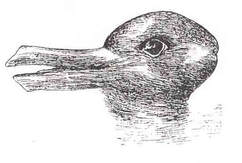
Perspective may also influence your perceptions. For example, there is a famous illusion, called the rabbit-duck illusion, in which the exact same image can be seen as a rabbit or a duck depending on how you look at it. So in this case the way you perceive the animal in the image is altered by your perspective.
Is Perception Subjective?
The number of different types of cells in our eyes, and the way that information travels through our brain and is processed and influenced by our perspective makes perception a subjective phenomenon. In other words (returning to the flower example), you and I can look at the same flower from the same angle, but the way my eyes are structured and the way visual information is processed in my brain could make the flower appear a little less red than it looks to you.
Perception Management
The methods used in perception management can include media manipulation, propaganda, and strategic communication. The goal of perception management is to present a positive image or message about a particular issue, event, person, or product, and to control the narrative and frame the discussion in a favorable way.
Perception management can have both positive and negative consequences, as it can be used to improve public understanding of important issues and promote positive change, but it can also be used to manipulate and deceive people, leading to distorted views of reality.

Articles Related to Perception
Books Related to Perception
Final Thoughts on Perception
Perception is an interesting cognitive phenomenon. It is multifaceted and can vary between people, even when they are ostensibly perceiving the same object. Our perceptions can be affected by several factors, and we should be wary of when they may be manipulated to suit the purposes of others. To learn more about perceptions, check out this video:
Video: Your Reality Might Not be Mine: Sensory Perception and Empathy
Don’t Forget to Grab Our Free eBook to Learn How to
Grow Your Wellness Business Exponentially!
References
- Ceunen, E., Vlaeyen, J. W., & Van Diest, I. (2016). On the origin of interoception. Frontiers in psychology, 7, 743.
- Droit-Volet, S. (2013). Time perception, emotions and mood disorders. Journal of Physiology-Paris, 107(4), 255-264.
- Eisenberger, N. I., & Lieberman, M. D. (2004). Why rejection hurts: a common neural alarm system for physical and social pain. Trends in cognitive sciences, 8(7), 294-300.
- Kleinke, C. L. (1978). Self-perception: The psychology of personal awareness. W. H. Freeman & Co.
- Levy, K. N., Ellison, W. D., Scott, L. N., & Bernecker, S. L. (2011). Attachment style. Journal of clinical psychology, 67(2), 193-203.
- Markus, H., Smith, J., & Moreland, R. L. (1985). Role of the self-concept in the perception of others. Journal of Personality and social Psychology, 49(6), 1494.
- Mikulincer, M., & Horesh, N. (1999). Adult attachment style and the perception of others: The role of projective mechanisms. Journal of personality and social psychology, 76(6), 1022.
- Rey, A. E., Michael, G. A., Dondas, C., Thar, M., Garcia-Larrea, L., & Mazza, S. (2017). Pain dilates time perception. Scientific reports, 7(1), 1-6.
Are You a Therapist, Coach, or Wellness Entrepreneur?
Grab Our Free eBook to Learn How to Grow Your Wellness Business Fast!
