
Relaxation: Definition, Techniques, & Videos
Relaxation might sound like an indulgence, but research shows it’s essential for our health and well-being. Learn more about relaxation and techniques for slowing down.

*This page may include affiliate links; that means we earn from qualifying purchases of products. |
In American culture, relaxation is considered a luxury, something only those privileged enough to have sufficient resources get to enjoy on occasion. However, relaxation is actually an important part of our mental and physical health. When we don’t allow ourselves to take time to unwind, the harmful effects of daily stressors begin to accumulate and can contribute to psychological and physical maladies like depression, memory loss, heart disease, stroke, and diabetes (just to name a few). Relaxing gives our bodies and minds a chance to recover from stress and live our best lives. |
Are You a Therapist, Coach, or Wellness Entrepreneur?
Grab Our Free eBook to Learn How to
Grow Your Wellness Business Exponentially!
✓ Save hundreds of hours of time ✓ Earn more $ faster
✓ Boost your credibility ✓ Deliver high-impact content
What Is Relaxation? (A Definition)
Relaxation is the absence of tension. When we’re relaxed our breathing is deep, our heart rate is steady, and our mind is clear. Physiologically, relaxation is the activation of our parasympathetic nervous system.
Our nervous system is divided into 2 branches: the central nervous system, which includes our brains and our spinal cord, and the peripheral nervous system, which includes everything else. The peripheral nervous system can be subdivided into 2 branches as well: the somatic nervous system, which facilitates voluntary movements and physical sensations like touch, and the autonomic nervous system, which governs involuntary muscle contractions (like your heartbeat) and internal sensations (like the way your stomach feels when you’re hungry).
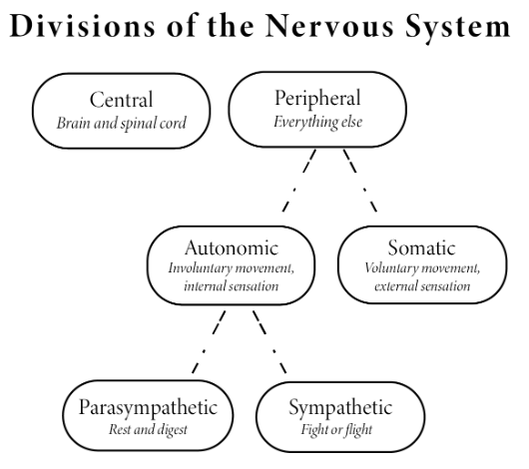
Activation of the sympathetic nervous system is not inherently a bad thing. It’s active when we’re falling in love, playing our favorite sport, or having an exciting conversation. In fact, research suggests that “good stress” (also called eustress)—that is, sympathetic activation in response to a favorable experience—is actually good for you. Chronic activation of this system, however, is where we start to get into trouble. When the sympathetic nervous system is active, our bodies release stress hormones that increase our heart rate and blood pressure and generally prepare our bodies to respond to a threat. When these hormones accumulate, they can cause damage to our bodies at a cellular level (McEwen, 2008).
Parasympathetic activation performs the opposite function. It slows our heart rate, lowers our blood pressure, reduces muscle tone, slows our breathing, and prepares our bodies for rest and rejuvenation. In other words, the parasympathetic nervous system helps us relax. Luckily, there are a number of ways we can activate our parasympathetic nervous systems and help our bodies recover from the damages of our stressful lives.

Techniques for Relaxation
There are many different methods of relaxation and not all of them will work great for everyone, so if you are having trouble calming your body and your mind, it might help to try a couple of different methods to see which works best for you. Here are a few examples from the Student Wellbeing Team at Cardiff University:
Video: Relaxation Techniques
Let’s dig a little deeper into some of these techniques.
Progressive Muscle Relaxation
In general, the steps to PMR are the following:
- Minimize distractions and interruptions (i.e. turn off your cell phone and find a quiet place).
- Lie down and make yourself as comfortable as possible.
- Begin with 1 muscle group, such as your feet. Inhale as you tighten the muscles in your feet and hold for 6-10 seconds then relax and exhale for 6-10 seconds. Be sure not to squeeze so hard that you cause cramping or discomfort.
- Repeat this step once more before moving on to another muscle group (such as the calves).
- Repeat steps 3 and 4 as you work your way up your body through different muscle groups (feet, calves, thighs, abdomen, hands, arms, back, then face).
If you’d like to be guided through a PMR exercise, you can check out this video:
Video: Guided Progressive Muscle Relaxation
Relaxation Meditation
Meditation and Trauma
The benefits of meditation are well-documented and difficult to dispute, but recent research suggests that meditation, especially mindfulness meditation, might not be for everyone. For people with post-traumatic stress disorder, diving right into meditation could do more harm than good. The hypothesis is that meditating could overwhelm some trauma survivors by creating “too strong a window of awareness” before they’re ready (Burrows, 2016). This isn’t to say that if you have trauma you shouldn’t meditate, only that it is best to approach meditation carefully, be aware of how your body is responding, and take a break as soon as you need to.
Relaxation and Massage
As someone who chronically carries tension in their neck and shoulders, I’ve noticed that one of my major barriers to relaxation is the pain caused by this muscle tension. Relaxing makes the pain more noticeable, so I’m compelled to stay busy to distract myself from it. Massages provide the relief I need to allow myself to genuinely let go of distractions and relax.
There are many forms of massage therapy, and each form is suited for different needs. For example, if your goal is simply relaxation, a Swedish massage might be best for you. Whereas if you are in need of pain relief, a deep-tissue massage could be the way to go. Before scheduling a massage session, it might be helpful to check out what your options are and discuss what type of massage will best meet your needs with your massage therapist.

Relaxation and Yoga
Research has shown that yoga can help reduce pulse rate, and blood pressure, both of which are important physiological changes for relaxation (Jain et al., 2010). Yoga has also been shown to reduce other physiological symptoms of stress such as inflammation and the production of stress hormones (Ross & Thomas, 2010).
Essential Oils for Relaxation
The precise biological mechanisms by which aromatherapy works aren’t entirely clear just yet. One hypothesis is that the odorant compounds released from the oils bind to receptors in your nose and then diffuse into your bloodstream where they can begin to affect different aspects of your nervous system. Another hypothesis is simply that we learn to associate smells with particular emotional experiences (Herz, 2009). Regardless of how aromatherapy works, there is good evidence to suggest that it is a simple and effective strategy for reducing psychological stress (Liu et al., 2013).
Relaxation essential oils list

Relaxation Music and Sounds
Listening to music is also well-documented as a helpful therapeutic technique for reducing stress. For example, listening to music has been shown to affect aspects of your physiology such as lowering your heart rate, reducing blood pressure, and limiting stress hormone levels (de Witte et al., 2022).
The neural mechanisms by which music improves mood, relaxation, and well-being are not well understood. One possibility involves the synchronization of our bodies and our brain activity with musical qualities such as rhythm and tempo (Kim et al., 2018). For example, you’ve probably noticed yourself involuntarily tapping your foot to the beat when listening to a song. This phenomenon is known as “entrainment” and is essentially the rhythm of the music influencing the rhythmic activity within your motor system.
In the case of stress, it is hypothesized that during music listening, the activity of your autonomic nervous system (the branch of the nervous system that contains the sympathetic and parasympathetic systems) is entrained to the rhythm of the music. Music therapists can help their patients achieve a slow and steady heart rate and respiratory rate by playing music with a slow tempo (Kim et al., 2018).
When using music to facilitate relaxation, the best kind of music to listen to is the kind that feels the best to you. Not everyone responds to music in the same way, so it is good to explore what gives you the greatest sense of calm. For example, some people enjoy unstructured, atmospheric soundscapes while others (myself included) find unstructured music irritating or even distressing.
Below are a couple of examples of music for relaxation. The first is an example of unstructured relaxing music and the second is an example of structured relaxing music.
Video: Beautiful Relaxing Music for Stress Relief
Video: Relaxing Guitar Music
Relaxation Music for Kids
Music listening is also a great way to help children calm down and unwind. Complicated soundscapes may not feel as soothing for kids as they can feel for adults, so it might be helpful to instead use slow tempo, soft music that is less complex than typical relaxation music for adults.
Here is a great example of relaxation music for kids:
Video: Relaxing Music For Children
Relaxation Videos
Research has shown that viewing images of nature can have a positive impact on stress and well-being. For example, one study showed that patients who were given images of nature reported less pain than those who were not (Vincent et al., 2010). Additional research points specifically to an increase in parasympathetic activity following viewing scenes of green spaces (van den Berg et al., 2015). Below are a few videos of calming, natural scenes that you might enjoy independently or in combination with other relaxation methods.
Video: Nature Morning 4K – Relaxation Film – Meditation Relaxing Music
Video: The Coral Reef: 10 Hours of Relaxing Oceanscapes | BBC Earth
Quotes on Relaxation
- “The point of gathering stillness is not to enrich the sanctuary or the mountain top, but to bring that calm into the motion, the commotion, of the world” – Pico Iyre
- “It takes courage to say yes to rest and play in a culture where exhaustion is seen as a status symbol.” – Brene Brown
- “To have faith is to trust yourself to the water. When you swim you don’t grab hold of the water because if you do you will sink and drown. Instead you relax, and float.” – Alan Watts
- “If you surrendered to the air, you could ride it” – Toni Morrison
Articles Related to Relaxation
Books Related to Relaxation
Final Thoughts on Relaxation
Don’t Forget to Grab Our Free eBook to Learn How to
Grow Your Wellness Business Exponentially!
References
- Bakkali, F., Averbeck, S., Averbeck, D., & Idaomar, M. (2008). Biological effects of essential oils – A review. Food and Chemical Toxicology, 46(2), 446–475.
- Burrows, L. (2016). Safeguarding Mindfulness Meditation for Vulnerable College Students. Mindfulness, 7(1), 284–285.
- Cawthorn, A., & Mackereth, P. A. (Eds.). (2010). Integrative hypnotherapy: complementary approaches in clinical care. Elsevier Health Sciences.
- De Benedittis, G. (2015). Neural mechanisms of hypnosis and meditation. Journal of Physiology Paris, 109(4–6), 152–164.
- de Witte, M., Pinho, A. da S., Stams, G. J., Moonen, X., Bos, A. E. R., & van Hooren, S. (2022). Music therapy for stress reduction: a systematic review and meta-analysis. Health Psychology Review, 16(1), 134–159.
- Dreyer, N. E., Cutshall, S. M., Huebner, M., Foss, D. M., Lovely, J. K., Bauer, B. A., & Cima, R. R. (2015). Effect of massage therapy on pain, anxiety, relaxation, and tension after colorectal surgery: A randomized study. Complementary Therapies in Clinical Practice, 21(3), 154–159.
- Herz, R. S. (2009). Aromatherapy facts and fictions: A scientific analysis of olfactory effects on mood, physiology and behavior. International Journal of Neuroscience, 119(2), 263–290.
- Jain, S., Jain, M., & Sharma, C. S. (2010). Effect of yoga and relaxation techniques on cardiovascular system. Indian Journal of Physiology and Pharmacology, 54(2), 183–185.
- Jane, S. W., Chen, S. L., Wilkie, D. J., Lin, Y. C., Foreman, S. W., Beaton, R. D., Fan, J. Y., Lu, M. Y., Wang, Y. Y., Lin, Y. H., & Liao, M. N. (2011). Effects of massage on pain, mood status, relaxation, and sleep in Taiwanese patients with metastatic bone pain: A randomized clinical trial. Pain, 152(10), 2432–2442.
- Kim, S., Gäbel, C., Aguilar-Raab, C., Hillecke, T. K., & Warth, M. (2018). Affective and autonomic response to dynamic rhythmic entrainment: Mechanisms of a specific music therapy factor. The Arts in Psychotherapy, 60, 48–54.
- Liu, S. H., Lin, T. H., & Chang, K. M. (2013). The physical effects of aromatherapy in alleviating work-related stress on elementary school teachers in Taiwan. Evidence-Based Complementary and Alternative Medicine, 2013.
- McEwen, B. S. (2008). Central effects of stress hormones in health and disease: Understanding the protective and damaging effects of stress and stress mediators. European Journal of Pharmacology, 583(2–3), 174–185.
- Perez-De-Albeniz, A., & Holmes, J. (2000). Meditation: concepts, effects and uses in therapy. International Journal of Psychotherapy, 5(1), 49–58.
- Ross, A., & Thomas, S. (2010). The health benefits of yoga and exercise: A review of comparison studies. Journal of Alternative and Complementary Medicine, 16(1), 3–12.
- van den Berg, M. M. H. E., Maas, J., Muller, R., Braun, A., Kaandorp, W., van Lien, R., Van Poppel, M. N. M., van Mechelen, W., & van den Berg, A. E. (2015). Autonomic Nervous System Responses to Viewing Green and Built Settings: Differentiating Between Sympathetic and Parasympathetic Activity. International Journal of Environmental Research and Public Health, 12(12), 15860.
- Vincent, E., Battisto, D., Grimes, L., & Mccubbin, J. (2010). The Effects of Nature Images on Pain in a Simulated Hospital Patient Room. Health Environments Research & Design Journal, 3(3), 42–56.
Are You a Therapist, Coach, or Wellness Entrepreneur?
Grab Our Free eBook to Learn How to Grow Your Wellness Business Fast!
