
Weekly Planning: Ideas, Templates, and Tips
What are the advantages of weekly planning? Discover ideas and tips to plan your week effectively and find the best method for you.
*This page may include affiliate links; that means we earn from qualifying purchases of products. |
Have you ever spent part of your Sunday dreading the week ahead? Thinking about everything you need to do in the next few days might stress you out, especially if you’ve just finished a whirlwind week that was neither efficient nor productive. Maneuvering between tasks throughout a week without a clear plan might feel like navigating through a choppy ocean on a cloudy night without a compass. |
Before reading on, if you’re a therapist, coach, or wellness entrepreneur, be sure to grab our free
Wellness Business Growth eBook to get expert tips and free resources that will help you grow your business exponentially.Are You a Therapist, Coach, or Wellness Entrepreneur?
Grab Our Free eBook to Learn How to
Grow Your Wellness Business Exponentially!
✓ Save hundreds of hours of time ✓ Earn more $ faster
✓ Boost your credibility ✓ Deliver high-impact content
What Is Weekly Planning? (A Definition)
Although weekly planning is similar to daily planning, a weekly plan isn’t the more extended version of a daily agenda. Whereas daily plans typically include specific time slots allocated for each task and activity, most weekly plans focus on setting and accomplishing short-term goals. Therefore, weekly planning can help you achieve your long-term goals by conquering their short-term components. Let’s discuss some ideas for fail-proof weekly planning.
Weekly Planning Ideas
Video: How to Gain Control of Your Free Time
Weekly Goal Planning
Weekly Meal Planning
Determine Your Duties
If more than one adult lives in your household, you might want to discuss whether and how to divide food-related tasks. If you agree on sharing responsibilities, try to be specific about everyone’s food-related tasks and when those tasks should be done. For instance, in a household with two adults, one person might plan the weekly menu, shop for ingredients, and clean and chop vegetables. The other person might cook and clean the dishes. In other households, one person might be responsible for all food-related tasks. In short, once you determine your duties, you may have a better idea about how to take action and how much time you might want to set aside for meal preparation.
Make a Recipe List
You might want to start by making a list of your favorite dishes. If there are dishes that you haven’t cooked before, try finding their recipes to see which ingredients you’d need and how much time you might spend on making them.
Check Your Fridge and Pantry
Cooking what you already have is essential for reducing food waste and saving you a trip to the store. Browse your recipe list or search online recipes that use the ingredients you already have. If you buy fresh ingredients, you may want to use them in as many dishes as possible.
Set Aside Time For Your Meal Preparation
When you cook your meals depends on your routine and personal preferences. Some people prefer cooking every evening, whereas others cook a few different meals on the weekend and reheat them before serving. Moreover, some individuals set up their slow cookers in the morning before they leave for work and return home to a warm meal. Regardless of which cooking schedule you prefer, consider cleaning, peeling, and chopping ingredients ahead of time to make the cooking time less stressful.
Try Weekly Meal Subscriptions
If you don’t have enough time to browse recipes, assess your inventory, shop for missing ingredients, or if you simply would like to try new cuisines, you might want to try a meal subscription service. Most meal subscription recipes are designed to be prepared relatively quickly. Furthermore, these subscription packages include all ingredients you need, which saves you a trip to the store and the time to think about what to eat for dinner for an entire week.

Weekly Exercise Planning
When designing and incorporating your exercise plan, you might want to consider factors such as your fitness goals, age, body composition, general fitness level, and whether you already have an exercise routine. For instance, if you are generally in good health but don’t have an established exercise routine, try choosing relatively easy workouts first and progress slowly. If you have any existing health conditions, consider talking to a health care professional before creating an exercise routine. Here are some questions that may help you get started with your weekly exercise planning.
- What are your goals? To lose weight, build muscles, increase stamina, train for a marathon?
- What type of physical activities do you enjoy?
- Where will you exercise? If it’s not at home, how will you get there, and how long will that take?
- Do you need to purchase any equipment, membership, or subscription?
- What time of the day do you prefer to work out?
- How many days per week would you like to exercise, and for how long?
Weekly Mental Wellness Planning
Practice Deep Breathing
You can’t avoid stressful situations indefinitely, and stress-inducing tasks might make regular appearances in your weekly routine. Taking deep breaths during stressful periods can slow down your heart rate and help you calm down (Van Diest et al., 2014). Try incorporating reminders into your plan to practice deep breathing before stressful activities, such as an important meeting with a client or a midterm exam.
Practice Mindfulness
Mindfulness is being aware of your experiences without passing judgments. Practicing mindfulness allows you to pay attention to your thoughts, sensations, and emotions. Being aware of what you think and feel can allow you to accept your thoughts and feelings and achieve an optimal mental balance. Although mindfulness is often incorporated into activities such as yoga and meditation, you can practice mindfulness anytime, anywhere.
Do Relaxing Activities
You might want to reserve some time each week for relaxing activities that will help you feel happier. These activities can be practicing yoga, tai chi, meditation, or running for some people. Others might prefer spending time in nature or losing themselves in a hobby. Yet, some feel happy and energized when they socialize with friends. Whatever your relaxing activities are, regularly engaging in them might help you feel joyful and give you a positive outlook.

Weekly Planning Checklist
Create a Weekly Planning Routine
You might want to dedicate the same block of time each week to your weekly planning. Many people prefer creating their weekly plans first thing on Monday. If that is too stressful for you or your Monday mornings are more hectic than on other days, you may try planning your week sometime over the weekend. I prefer creating my weekly plan on Friday evenings because knowing when I will tackle which tasks in the next few days relieves my stress levels and allows me to enjoy my weekends without any worries.
Prioritize
Not everything on your to-do list is equally important. According to the 80-20 rule or Pareto Principle, twenty percent of activities are associated with eighty percent of consequences. Thus, a small fraction of items on your to-do list carries the most value for your time, whereas a large portion of your to-do list consists of relatively trivial tasks. Before you plan your week, you might want to determine which tasks and activities fall into this category and prioritize them over others.
Prioritizing tasks doesn’t have to be complicated. For instance, you might want to rank the items on your list from highest to lowest priority and allocate more time for the items on top. Yet, if you are having trouble determining which task is a higher priority, here is a method you can try.
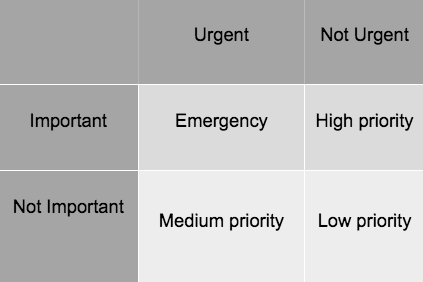
Simply, you’d need to create a table with two entry columns, one labeled “urgent” and the other one “not urgent,” and two entry rows labeled “important” and “not important.” Now, all you would need is to take your to-do list and enter all items into the appropriate box. You might want to aim to prioritize the tasks in the upper half of the table when creating your weekly plan.
The only thing a due date on your planner tells you is when you need to submit an assignment or finish a task. Instead of entering deadlines in your weekly plan, try creating subtasks related to the due date and adding them to your schedule. For example, if you have a project due on Thursday, you might want to divide the project into smaller pieces, such as doing research, creating an outline, writing up the project, and editing the final draft.
Don’t Forget You
Some people write down only their professional or academic tasks when creating their weekly plans. However, an effective schedule includes times for personal and other pursuits as well. It also has adequate time for self-care and fun activities. When planning your week, try to keep your personal goals and other non-professional objectives in mind.
Keep It Flexible
Having a flexible plan can help you avoid overbooking yourself. It is easy to underestimate how long an activity or an assignment will take. Moreover, life doesn’t always go according to plan, and you may have to deal with an unexpected issue such as a power outage, a broken car, a sick child, a lost wallet, or a malfunctioning computer. Keeping your weekly plan flexible means you’ll have the ability to switch things around if needed so that you can tackle your highest priorities as soon as you can.
Keep It Visible
When it comes to weekly plans, out of sight means out of mind. Once you create your weekly plan, you might want to keep it somewhere nearby, so you can reach it easily. For instance, I use a weekly planning pad that I keep next to my keyboard on my desk to refer to it throughout the day and adjust it whenever needed, such as when meetings get rescheduled.
Keep it Simple
You don’t need to enter all the details for each task or the exact time you will start or finish them. Keeping your weekly plan simple will allow you to see the big picture and focus on progressing toward your goals instead of getting lost in the details of individual tasks and activities.
Find a Weekly Planning Method That Works For You
There are a lot of planners, apps, templates, and other resources available. You may hear a friend, family member, or an influencer swear by one or two of them. But just because something works for someone else doesn’t guarantee it will work for you as well. Everyone has different needs and tastes, and a fun method for your friend may feel like a burden to you. For instance, some people like a particular app to plan their week, but others prefer using a template they printed out or a whiteboard on their fridge door. It is up to you to decide which method works best for you.
If you’d like to learn more about how to plan your week, you may enjoy the video below.
Weekly Planning: A Video From the Seven Habits of Highly Effective People
Weekly Planning Using a Whiteboard
- A magnetic weekly planner with a simple design that can stick to your fridge is one of the best options if you aim to keep your weekly plan visible to the entire family.
- A weekly planner whiteboard that is larger than a magnetic planner might be a better investment if you require more writing space.
Weekly Planning Sheets
- This pink template has dedicated boxes for goals and to-do items so that you can keep an eye on your weekly goals.
- This green template has a similar design, but a larger space for your general to-do list.
- Even looking at this beautiful template is enough to motivate me to start planning my week.
Weekly Planning Calendar
- A weekly planning pad, such as this one, has a fun design and plenty of room to fit the items on your weekly plan.
- If you wish to have space for your weekly goals and general to-do items, this weekly planner notepad has everything you need.
- This weekly planner calendar has a clean look and offers space for your goals and priorities.
- You can also use a weekly planner dedicated to and designed explicitly for meal planning.
Weekly Planning Journals
- This classic Legend Planner is easy to carry in your purse or backpack yet has everything you might need to organize your schedule.
- This weekly organizer journal is similar in design but comes in a more compact size.
Weekly Planning Apps

Articles Related to Weekly Planning
Weekly Planning Books
Final Thoughts on Weekly Planning
Handling tasks and responsibilities without clear goals is stressful and minimally productive. Weekly planning allows you to consider your short-term goals and allocate your time effectively over a week. A good weekly plan takes all aspects of your life into account and helps you achieve both your professional and personal goals.
Don’t Forget to Grab Our Free eBook to Learn How to
Grow Your Wellness Business Exponentially!
References
- Garcia, A. L., Reardon, R., Hammond, E., Parrett, A., & Gebbie-Diben, A. (2017). Evaluation of the “eat better feel better” cooking programme to tackle barriers to healthy eating. International journal of environmental research and public health, 14(4), 380.
- Van Diest, I., Verstappen, K., Aubert, A. E., Widjaja, D., Vansteenwegen, D., & Vlemincx, E. (2014). Inhalation/exhalation ratio modulates the effect of slow breathing on heart rate variability and relaxation. Applied psychophysiology and biofeedback, 39(3), 171-180.
- Wack, S. R., Crosland, K. A., & Miltenberger, R. G. (2014). Using goal setting and feedback to increase weekly running distance. Journal of applied behavior analysis, 47(1), 181-185.
- World Health Organization. (2010). Global recommendations on physical activity for health. World Health Organization Report.
Are You a Therapist, Coach, or Wellness Entrepreneur?
Grab Our Free eBook to Learn How to Grow Your Wellness Business Fast!
